
Most of what I’ve written on this blog about enhanced Housing Benefit has been about the gateway to it. That means whether the landlord qualifies, whether the care, support or supervision is “more than minimal”, and whether intensive housing management and maintenance count. This post is about the next question, which gets far less attention: once a claim is accepted as exempt accommodation, when can a council say the rent is too high?
Councils and providers both get this wrong, in opposite directions. Some councils treat the Rent Officer’s figure as a ceiling, or pick a local “benchmark” and restrict anything above it. Some providers think that, once a scheme is exempt, the rent can’t be challenged at all. Neither is right. The rules are old, the case law is spread across thirty years of decisions, and very little of it has been brought together with supported housing in mind. This post tries to do that.
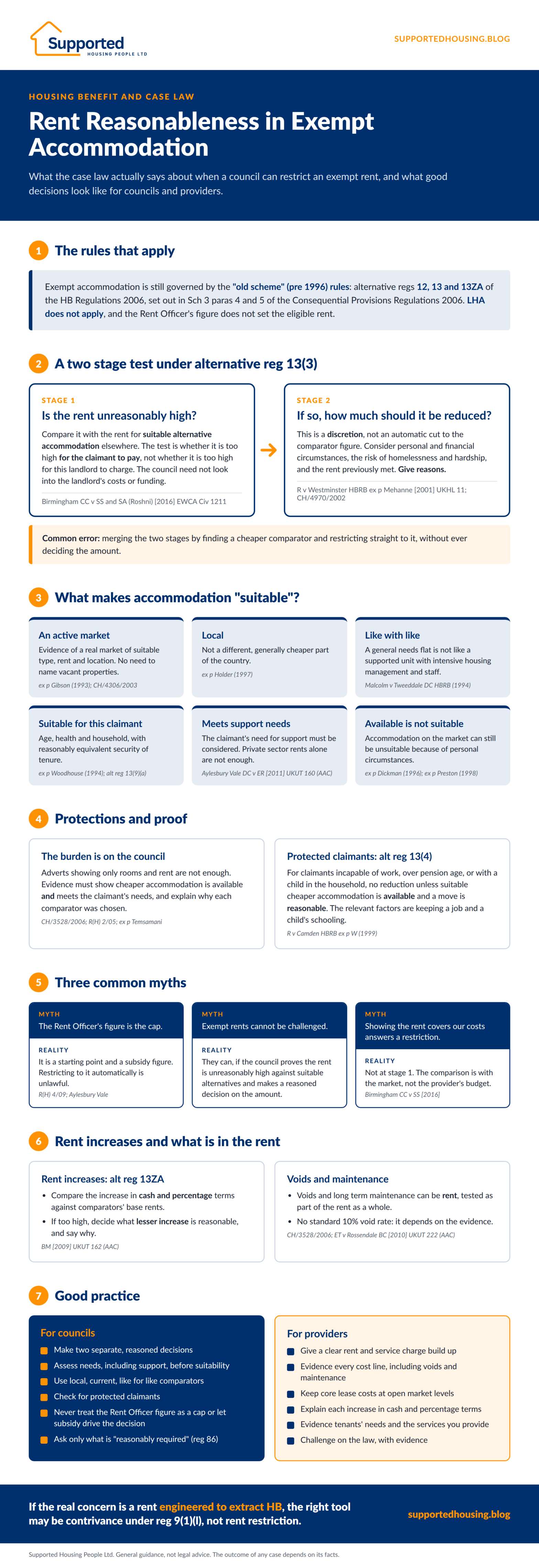
The rules that apply
Exempt accommodation is still governed by the “old scheme” rules, the rent restriction rules that applied before January 1996. These now appear as the alternative versions of regulations 12, 13 and 13ZA of the Housing Benefit Regulations 2006. They are set out in paragraphs 4 and 5 of Schedule 3 to the Housing Benefit and Council Tax Benefit (Consequential Provisions) Regulations 2006. Local Housing Allowance doesn’t apply, and the Rent Officer’s determination doesn’t set the claimant’s eligible rent.
Under alternative regulation 13(3), a council can reduce the eligible rent only if it finds that:
- the dwelling is larger than the claimant reasonably needs, or
- the rent is unreasonably high compared with the rent payable for suitable alternative accommodation elsewhere.
Even then, the council reduces the eligible rent by “such amount as it considers appropriate, having regard in particular to the cost of suitable alternative accommodation elsewhere”.
So there are two separate stages:
- Is the rent unreasonably high compared with suitable alternative accommodation?
- If so, by how much should it be reduced?
Many restriction decisions I see fail because they merge the two stages. The council finds a cheaper comparator and restricts the rent to it, without ever making the second decision.
Stage one: “unreasonably high” compared with what?
The leading authority is the Court of Appeal’s decision in Birmingham City Council v SS and SA (Roshni intervening) [2016] EWCA Civ 1211; [2017] AACR 8. It is essential reading for anyone in this area.
Roshni is a registered charity running a refuge for South Asian women escaping domestic abuse. It lost its Supporting People funding, which it had been using to subsidise rents, through no fault of its own. It then raised its rents to cover its costs. Birmingham restricted the eligible rent from £242.17 to £179.20 a week, using as comparators other refuges that were still publicly subsidised. The Upper Tribunal found for the claimants. It reasoned that comparing an unsubsidised charity with subsidised ones was not comparing like with like, and that the rent was reasonable given Roshni’s circumstances.
The Court of Appeal disagreed and sent the cases back to the Upper Tribunal. It held that:
- the test is whether the rent is unreasonably high for the claimant to pay, compared with rents for suitable alternative accommodation in the market. It is not whether the rent is unreasonable for this particular landlord to charge.
- regulation 13(3)(b) does not require the council to look into the landlord’s costs, funding or circumstances.
The Court of Appeal did not decide how much Housing Benefit the claimants should get. It sent the cases back to the Upper Tribunal to decide two questions under the correct test: whether the rent was in fact unreasonably high, and if so, what reduction would be appropriate given the claimants’ circumstances and the discretion described in Mehanne. I haven’t been able to find any published Upper Tribunal decision after the cases were sent back, so Birmingham is authority on the approach, not on the outcome for Roshni’s residents.
This matters for providers. A transparent rent build-up showing that the rent covers real costs is good practice. I’d always recommend one, and it is directly relevant to service charges. But it isn’t a defence to a stage-one finding that the rent is unreasonably high. The comparison is with the market for suitable alternative accommodation, not with the provider’s budget.
It also matters for councils, because Birmingham does not make restriction easy. The council still has to show that suitable alternative accommodation exists, and the case law on what “suitable” means places real demands on it.
What counts as “suitable alternative accommodation”?
This is where most restriction decisions succeed or fail. The principles from the case law are:
There must be an active market. The council doesn’t need to identify particular vacant properties. It does need evidence of a real market in accommodation of a suitable type, at a suitable rent, in a suitable location. See R v East Devon DC HBRB ex p Gibson (1993) 25 HLR 487 (CA) and CH/4306/2003. The Court of Appeal in Gibson also said that the rules exist to protect public funds, but were not designed to make people homeless.
It must be local. You can’t compare with accommodation in a different, generally cheaper part of the country. See R v Waltham Forest LBC ex p Holder (1997) 29 HLR 71.
It must be like with like. See Malcolm v Tweeddale DC HBRB [1994] SLT 1212. In supported housing this is the critical point. A one-bedroom flat at market rent is not like an exempt unit with intensive housing management, enhanced maintenance, communal facilities and on-site or on-call staff.
It must be suitable for this claimant. The question is whether the alternative is suitable for the claimant, not for people in general. See CH/3528/2006, para 34, and the DWP guidance, para 214. The regulations require the council to consider the nature and facilities of the alternative, having regard to the age and health of the claimant and their household. Where the claimant has security of tenure, the alternative must offer reasonably equivalent security (alternative regulation 13(9)(a)).
It must meet the claimant’s support needs. In Aylesbury Vale DC v ER [2011] UKUT 160 (AAC) (CH/1961/2010), the council compared the claimant’s exempt rent of £178.31 with private sector one-bedroom rents. The Rent Officer had given a figure of £95. The Upper Tribunal set the decision aside. The council had to consider the claimant’s actual housing needs, including her need for support. It didn’t have to require that support to come from the landlord, but it couldn’t ignore it either. In CH/3528 to 3560/2007, the alternative had to meet the tenants’ specific needs, such as room sizes and wheelchair access, not just look similar on paper.
Available is not the same as suitable. Accommodation can be on the market but unsuitable for a particular claimant because of their circumstances. See R v Oadby and Wigston BC ex p Dickman (1996) 28 HLR 806, which also says that a claimant who argues that identified accommodation is unavailable needs to explain why. A council also has to deal with the claimant’s evidence that their current home is particularly suitable for their needs. See R v East Devon HBRB ex p Preston (1998) 31 HLR 936.
The burden is on the council
A council that wants to restrict an exempt rent needs evidence that will stand up at tribunal. In CH/3528/2006, the council’s evidence was newspaper advertisements showing only the number of rooms and the rent. The Commissioner held that this wasn’t enough even to put an evidential burden on the claimant. The evidence needs to be general enough to show that cheaper alternatives are
Protected claimants and “reasonable to expect them to move”
Alternative regulation 13(4) adds a further protection. For certain claimants, the council can’t make any reduction unless suitable cheaper alternative accommodation is available and it is reasonable to expect the claimant to move. The protected groups are:
- People incapable of work: claimants unable to work because of illness, disability or incapacity.
- People over pension age: claimants who have reached State Pension age (see HB Adjudication Circular A9/2024).
- Households with children: households that include a child or young person for whom the claimant or their partner is responsible.
Many exempt accommodation tenants fall into these groups. For them, the council has to go further than showing a pool of comparable accommodation. It has to show that suitable accommodation is actually available and that a move is reasonable.
The factors the council can consider when deciding whether a move is reasonable are limited. R v Camden HBRB ex p W (1999) 32 HLR 879 (CA) held that they are the claimant’s prospects of keeping their job and, where a move would mean a change of school, the education of a child or young person. Health is not one of those factors. But R v Westminster HBRB ex p Pallas [1997] EWHC Admin 818 held that a substantial health risk from moving can still be relevant to whether suitable alternative accommodation exists at all.
Stage two: the amount of the reduction
If the council gets through stage one, it still has a discretion. It is not required to reduce the rent to the comparator figure.
The House of Lords in R v Westminster HBRB ex p Mehanne [2001] UKHL 11, [2001] 1 WLR 539 held that the cost of suitable alternative accommodation must be considered, but it isn’t the only consideration. The council can and should take account of other relevant circumstances. These include the claimant’s personal and financial circumstances, how hard it would be to find somewhere else, and what moving would mean for them, including the risk of homelessness or hardship.
In Birmingham, the Court of Appeal confirmed that the council has a discretion over the amount and need not reduce the rent by the full difference. According to the Shelter Legal summary, there may be a strong case for limiting a reduction where a larger one would lead to homelessness. That point matters a great deal in supported housing, because many tenants have no realistic alternative.
The council must actually make this decision and give reasons. CH/4970/2002 makes that clear. In Aylesbury Vale, the Upper Tribunal noted that the council had previously met £133.57 a week for the same property. On the face of it, a restriction below that figure was hard to justify.
The council also shouldn’t reduce the eligible rent below the cost of suitable alternative accommodation. That principle is usually attributed to R v Brent LBC ex p Connery [1990] 2 All ER 353, (1989) 22 HLR 40.
Rent increases
Rent increases have their own test under alternative regulation 13ZA, the old regulation 12. The question is whether the increase is unreasonably high, having regard in particular to increases for suitable alternative accommodation.
In BM [2009] UKUT 162 (AAC) (CH/2036/2008), the Upper Tribunal held that:
- the increase must be looked at both as a percentage and in cash terms, against the base rents and resulting rents of the comparators. A flat percentage cap won’t do.
- there is no fixed checklist of relevant factors.
- if the requested increase is unreasonable, the decision maker must go on to decide whether a smaller increase is reasonable and explain why. Just endorsing a council’s chosen percentage (3.5% in BM) wasn’t enough.
For providers, the lesson is simple. Explain every increase in writing, with the cost lines that have changed.
What goes into the rent?
In CH/3528/2006, charges for voids and long-term maintenance were held to be part of the rent, not service charges. They are therefore tested as part of the rent as a whole under alternative regulation 13. They are not picked off one by one as “ineligible” under Schedule 1. That doesn’t make any void allowance acceptable. In ET v Rossendale BC [2010] UKUT 222 (AAC) (CH/3677/2008), the Upper Tribunal explained that CH/3548/2006 did not establish 10% as a standard rate. The right allowance depends on the evidence. ET also confirms that, for service charges, comparables are not a precondition to finding a charge excessive, although they must be considered where they exist.
This is where the rules on rent and on service charges meet. My earlier post on the “more than minimal” myth discusses Allerdale BC v JD and Others [2019] UKUT 304 (AAC). That case confirms that exempt status doesn’t automatically make every service charge eligible. Restrictions on the core rent and challenges to service charges are separate exercises, and decision letters should keep them apart.
The Rent Officer’s figure is not a cap
Councils refer exempt rents to the Rent Officer, and the determination affects subsidy. It does not set the claimant’s eligible rent. In old scheme cases, the council can’t restrict to the Rent Officer’s figure unless suitable alternative accommodation is available and it is reasonable to expect the claimant to move. See R(H) 4/09, which sums up the position. In Aylesbury Vale, the Rent Officer’s £95 was a starting point, not the answer.
I understand the financial pressure on councils. In its evidence to the Exempt Accommodation inquiry, Bristol City Council set out how the loss of subsidy above the Rent Officer’s figure falls on the council. For a vulnerable claimant, 60% of the excess is subsidised. For other claimants, none of it is. Loss of subsidy is a real problem, but it isn’t a lawful reason to restrict a claimant’s rent. A decision driven by subsidy instead of the regulations won’t survive an appeal.
When the problem isn’t the rent
Bristol’s evidence makes another point worth repeating. Restricting exempt rents is legally difficult, and it was right to say so. Bristol also described a “rent escalator”, where each accepted exempt rent becomes the benchmark for the next. Bristol recommended that core lease costs be set at open-market levels.
Where the real concern is that a rent has been inflated to extract Housing Benefit, through head leases, connected companies or circular flows of money, the right tool may not be rent restriction at all. As I wrote in The End of the Property-Led Exempt Accommodation Contrivance?, the Upper Tribunal has confirmed that contrivance under regulation 9(1)(l) can be established by evaluative judgment on the arrangement as a whole. Councils should use the right tool for the right problem, and avoid stretching rent restriction to do a job it was never designed for.
Good practice for councils
- Treat the decision as two stages, and give reasons for each.
- Assess the claimant’s needs before deciding what is suitable, including their need for support.
- Use comparators that are local, current, like for like, and backed by enough detail to show they are suitable. Asking rents in adverts won’t be enough.
- Check whether the claimant is in a protected group, and if so whether a move is reasonable on the permitted factors.
- At stage two, consider personal circumstances, the risk of homelessness and the rent previously met. Do not default to the comparator figure.
- Don’t treat the Rent Officer’s figure as a cap or let subsidy loss drive the decision.
- Keep a record of the evidence as it stood at the date of the decision. Tribunals look at the circumstances at that date.
- Ask only for information that is “reasonably required” under regulation 86. Explain why the information you already hold isn’t enough.
Good practice for providers
- Provide a clear rent and service charge build-up, with the basis for each cost line, including voids, maintenance, management and lease costs.
- Make sure core lease costs are defensible against open-market rents for the property.
- Explain every increase in writing, in cash and percentage terms, showing which costs have changed.
- Know your tenant group. Evidence of needs and of the support and housing management you provide is relevant to suitability, not only to exempt status.
- Where a restriction looks wrong, ask the council what comparators it used and how it decided they were suitable. Then challenge the decision on the law, with evidence.
Conclusion
The rules on exempt rents are protective, but they aren’t a blank cheque. Councils can restrict rents that are genuinely unreasonably high. To do that lawfully they need proper evidence of suitable alternatives, they must respect the protections in regulation 13(4), and they must make a reasoned decision on the amount. Providers can’t rely on their own costs to answer a valid comparison. They can expect decisions to be properly evidenced, specific to the claimant, and explained.
Good decisions on rent reasonableness come from both sides doing the work, and from early, open conversations about how a rent has been set. That is the approach we’ll be taking in the good practice manual for council HB teams and providers that Supported Housing People is currently developing.
If you’d like help with a rent restriction decision, an appeal or a rent build-up, get in touch.
This post is general guidance, not legal advice. The outcome of any case depends on its facts.