
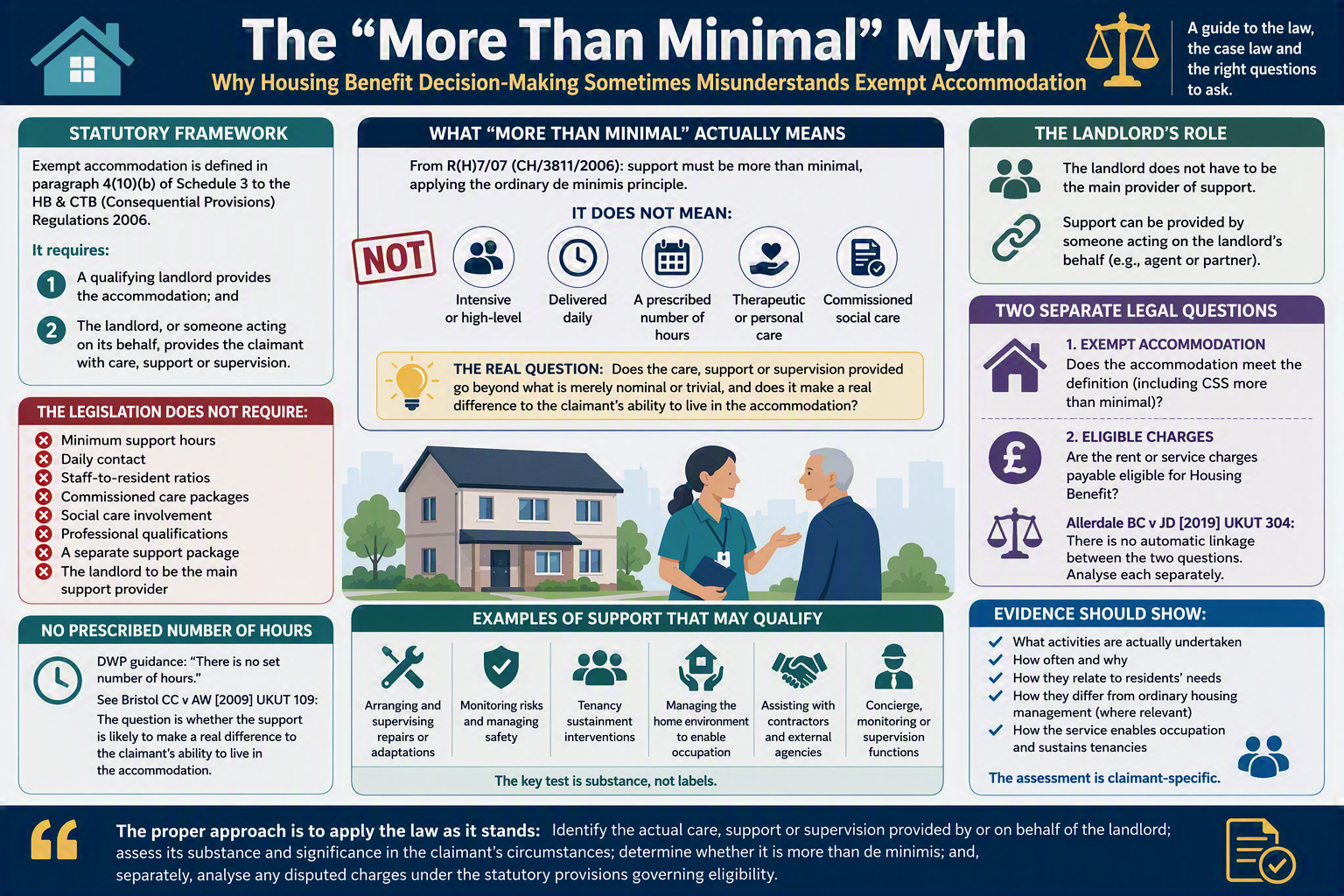
Why Housing Benefit Decision-Making Sometimes Misunderstands Exempt Accommodation
Introduction
The legal requirement that care, support or supervision (CSS) be “more than minimal” for exempt accommodation purposes is well established. However, problems arise when some revenues and benefits colleagues elevate this relatively modest threshold into a requirement for substantial personal support, prescribed support hours, daily interventions, commissioned care packages, or specialist social care provision. Both revenues and benefits colleagues and supported housing providers will be aware of this debate.
Neither the legislation nor the case law imposes such requirements. The correct legal question is whether a qualifying landlord, or someone acting on its behalf, provides CSS that is more than merely trivial or de minimis. The assessment is qualitative rather than quantitative and must be based on the actual services provided to the claimant.
The Statutory Framework
Exempt accommodation is defined in paragraph 4(10)(b) of Schedule 3 to the Housing Benefit and Council Tax Benefit (Consequential Provisions) Regulations 2006.
Accommodation will qualify where:
- It is provided by a qualifying landlord; and
- The landlord, or a person acting on its behalf, provides the claimant with care, support or supervision.
Notably, the legislation doesn’t require:
- A minimum number of support hours
- Daily contact
- Particular staff-to-resident ratios
- Commissioned care services
- Social care involvement
- Professional qualifications
- A separate support package
- The landlord to provide the majority of the claimant’s support.
The regulations do not define CSS in detail, leaving interpretation largely to the courts and tribunals.
What “More Than Minimal” Actually Means
The leading authority is R(H)7/07 (CH/3811/2006).
Commissioner Turnbull held that support must be more than minimal, applying an ordinary de minimis principle. He also rejected any requirement that the landlord be the claimant’s principal support provider.
Importantly, the decision does not suggest that support must be:
- Intensive
- Therapeutic
- High level
- Professionally commissioned
- Delivered daily
- Provided for a prescribed number of hours.
The threshold is simply whether the CSS goes beyond being nominal or trivial.
No Prescribed Number of Support Hours
A persistent misconception is that exempt accommodation requires a minimum number of support hours, often expressed as two or three hours per week.
Neither legislation, case law nor DWP guidance supports this proposition.
Current DWP guidance explicitly states that there is “no set number of hours required.” Revenues and benefits colleagues should instead examine:
- The nature of the activities
- The time involved
- The claimant’s circumstances
- The overall impact of the service
In Bristol City Council v AW [2009] UKUT 109 (AAC), Judge Turnbull suggested the practical question is whether the support provided is likely to make “a real difference to the claimant’s ability to live in the accommodation.” The focus is therefore on effectiveness, not the number of hours.
A rigid rule requiring daily contact, prescribed hours, or minimum staffing levels has no basis in the statutory scheme.
What Counts as Support?
Tribunal authorities have established that support is not confined to counselling, personal care, therapy, or social work interventions. These are services I would frame as “personal support” in this context and are not HB-eligible.
In Chorley BC v IT [2009] UKUT 107 (AAC), Judge Turnbull described support as including “advice and assistance with the practicalities of life, particularly occupation of the accommodation. “
The case is significant because tenants already received substantial support from another organisation. Nevertheless, the landlord’s activities were still capable of amounting to support.
This matters greatly for supported housing, both agency-managed and directly managed, that has CSS provided by or on behalf of a third-party (i.e. not the landlord). This supported housing can be wrongly designated as “Managed Property” (Specified Accommodation Category 2) in circumstances where the landlord’s activities were still capable of amounting to support in their own right.
The Tribunal recognised that housing-related activities, including repairs and maintenance undertaken in response to the needs created by tenants’ disabilities, could constitute support where they went beyond ordinary landlord functions.
Similarly, Chorley BC v EM [2009] UKUT 108 (AAC) recognised that arranging adaptations, inspections and housing-related interventions may amount to support depending on their nature and purpose.
The key issue is substance rather than labels. Calling an activity “housing management” does not prevent it from being support, just as calling something “support” does not automatically make it so.
Intensive Housing Management and Maintenance
A common error is to assume that housing management can never satisfy the CSS requirement. The case law does not support such a blanket proposition.
The correct comparison is with ordinary general needs housing management. Activities that materially exceed what would normally be provided due to a claimant’s vulnerabilities may constitute support or supervision.
Examples may include:
- Repeated tenancy-sustainment interventions
- Monitoring risks arising from vulnerability
- Managing the home environment to enable continued occupation
- Coordinating disability-related repairs or adaptations
- Assisting tenants in dealing with contractors and external agencies
- Supervising works necessary for safe occupation
- Concierge or monitoring services that provide a genuine protective function
Similarly, repair and maintenance activities are not legally incapable of constituting support. In Chorley BC v IT, the Tribunal expressly recognised that maintenance-related work may amount to support depending on its nature, extent and relationship to the claimant’s needs.
The legal question is not whether the activity falls under a housing management label but whether, in substance, it provides support or supervision to the claimant.
Ordinary Housing Management Remains the Boundary
This does not mean all landlord activities automatically constitute support.
Routine functions such as:
- Standard rent collection
- Routine repairs
- General administration
- Ordinary tenancy management
will not normally qualify merely because the tenant is vulnerable.
The distinction lies in whether the activity goes beyond ordinary housing management and is undertaken specifically to meet needs arising from the claimant’s circumstances.
The Landlord Need Not Be the Main Support Provider
Another recurring misunderstanding is the belief that the landlord must provide most of the claimant’s support. R(H)7/07 expressly rejected this proposition.
Accommodation may qualify as exempt even where another organisation provides the claimant’s principal care package, provided the landlord or someone acting on its behalf supplies CSS that is more than minimal.
This principle is particularly important in agency-managed and partnership-supported housing models.
The Myth of “Additional Non-Housing Benefit Support”
Some councils reason that intensive housing management is merely housing management and therefore cannot count as CSS. They then require providers to demonstrate a separate package of non-Housing-Benefit-funded support. That reasoning introduces requirements not found in the legislation.
If the housing management, supervision, maintenance interventions or tenancy-sustainment activities already constitute CSS and are more than minimal, there is no obvious legal basis for requiring an additional layer of separately funded support solely to satisfy an assumed supported-housing model.
My earlier Briefing (Intensive Housing Management and Maintenance are Support, Supervision, and Sufficient) expands on this point.
Exempt Accommodation and Eligible Charges Are Separate Questions
Confusion often arises between:
- Whether accommodation meets the definition of exempt accommodation; and
- Whether particular charges are eligible for Housing Benefit.
These are distinct statutory questions. The fact that a service contributes to CSS does not automatically determine whether the associated charge is eligible. Equally, a charge being ineligible does not prevent a service from being relevant to exempt accommodation status.
This distinction was emphasised in Allerdale BC v JD and Others [2019] UKUT 304 (AAC), where the Upper Tribunal stated there is “no automatic linkage” between the exempt accommodation definition and the provisions governing ineligible service charges.
The Tribunal examined enhanced housing management charges individually and apportioned eligible and ineligible elements rather than treating the entire charge as automatically excluded.
Revenues and benefits colleagues must therefore analyse both questions independently.
Evidence Matters More Than Labels
The key evidential question is what is actually delivered.
Providers should be able to demonstrate:
- Who provides the service;
- Their relationship to the landlord
- What activities are undertaken
- How often they occur
- Why they are necessary
- How they relate to residents’ needs
- How they differ from normal housing management where relevant
- How they help residents occupy and sustain their accommodation
Evidence of support hours may assist, but hours are not the legal test. Nor is a generic description of “intensive housing management” sufficient without evidence of the underlying activities.
The assessment is claimant-specific and fact-sensitive.
Conclusion
The requirement that CSS be “more than minimal” is not a myth in and of itself. It is an established legal test derived from R(H)7/07. The myth is the assumption that this threshold requires substantial personal support, prescribed support hours, daily interventions, commissioned care, or a separate package of non-housing support.
The legislation imposes none of those requirements.
The authorities establish that support may be practical, housing-related and consist of intensive housing management, supervision, maintenance, adaptations and tenancy-sustainment activities. The key question is whether those services amount to genuine support or supervision that is more than de minimis in the claimant’s circumstances.
There is no statutory hourly threshold, no requirement that the landlord be the main support provider, and no requirement for a separate care package. Equally, ordinary landlord functions do not automatically become support simply because a tenant is vulnerable.
Decision-makers should therefore focus on the actual services provided, their significance for the claimant, and whether they make a real difference to the claimant’s ability to occupy and sustain their accommodation. That is the qualitative, evidence-based assessment required by the legislation and the case law.
Michael Patterson
25th August 2026
One comment