
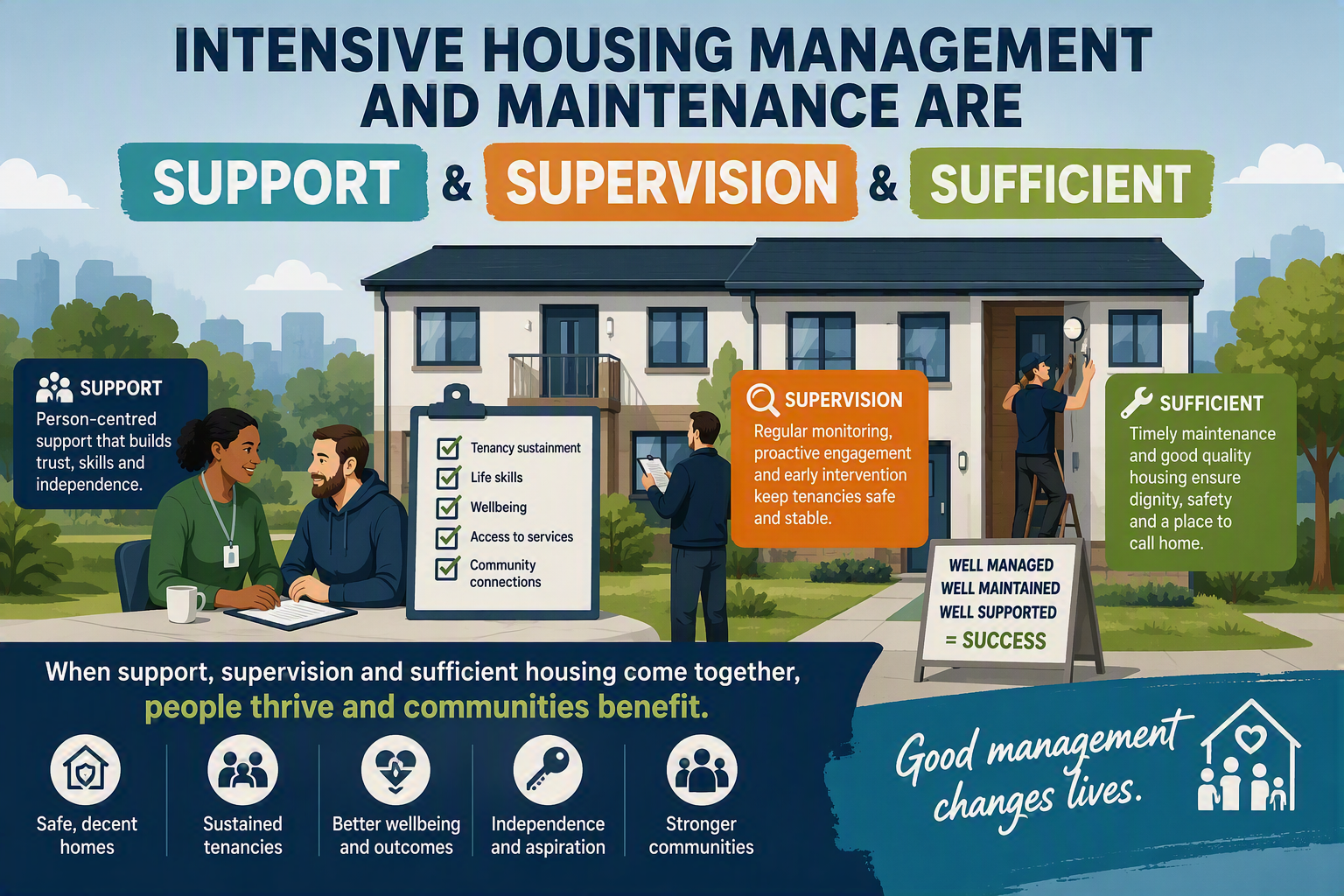
The Purpose of This Briefing
This note sets out the key case law underpinning a practical and defensible position for supported housing providers: that “Intensive housing management and maintenance are support, supervision and sufficient.” Remember where you heard that first!
That strapline isn’t AI-generated; however, I have used AI (and checked its output) to research some of the case law (DW vs Oxford) and to test some of my assumptions.
This is in circumstances where supported housing providers are often told by DWP and revenues and benefits colleagues that “care, support or supervision are not HB-eligible”, and that Intensive housing management and maintenance are not sufficient on their own. This isn’t true.
We have seen good providers and services defunded because of this mistaken belief, and it is highly likely that scrutiny of so-called “IHM-only” supported housing will increase.
These arguments also apply to supported housing where (non-HB-eligible) care, support or supervision is provided by an agent on behalf of a council or the NHS. Usually, these supported housing services are designated as “Managed Property” (specified accommodation category 2), the poor relative in resourcing terms compared with “Exempt Accommodation” (specified accommodation category 1). However, if the agent who provides the CSS on behalf of the council or the NHS also provides HB-eligible intensive housing management and/or maintenance on a contractual basis on behalf of the landlord, it’s Exempt Accommodation on the same basis that IHM-only supported housing is.
You can use the arguments below and the case law to inform your own position when appealing or challenging housing benefit decisions, or you can contact us to help you.
The Briefing explains:
- What legally counts as “support”
- When housing management crosses the line into support
- How to demonstrate sufficiency
- How to position your service in audits, reviews, and Housing Benefit appeals
1. The Anchor Principle: Support is Broad and Practical
CH/4432/2006 Chorley BC v EM
This is the foundation case every provider should understand.
The Upper Tribunal confirmed that “support” includes:
- Arranging and coordinating repairs
- Liaising with contractors
- Managing the home environment
- Organising works in ways that reduce tenant distress
In other words, support is about helping someone cope with living in their home, not just providing care or counselling.
What this means for providers
Activities often labelled as “housing management” can, in fact, be:
- Support
- Essential tenancy sustainment
- HB-relevant eligible provision
Especially where they are:
- Structured
- Repeated
- Tailored to vulnerability
2. The Legal Test for Sufficiency: “More than Minimal” and “Real Difference”
CH/200/2009 Bristol CC v AW
This is the key case on whether support is enough.
The Tribunal held:
Support must be
- More than minimal, and
- Likely to make a real difference to the claimant’s ability to live in the accommodation.
- This cannot always be quantified purely in terms of staff time (maintenance, overhead management costs, etc.), and the DWP’s own Guidance on the administration of Housing Benefit for supported housing says “There is no set number of hours that must be provided for the care, support or supervision to be sufficient.”
Critical takeaway
- The name of the service does not matter (“support” is fine, “floating support” is specifically excluded in DWP Guidance, although I think that’s challengeable)
- The cost does not matter (provided it isn’t “unreasonable”)
- The impact does matter
- Quantification of “support” in terms of hours is neither necessary nor workable
Even relatively low-level but structured support can qualify if it genuinely enables occupation.
R(H) 7/07: The “more than general needs” rule
This decision makes clear:
- Support must be more than minimal, AND
- Must go beyond ordinary landlord functions
This creates the key dividing line:
| General Needs Landlord | Supported Housing Provider |
| Reactive repairs | Managed, supported repairs with tenant engagement |
| Rent collection | Tenancy sustainment and budgeting support |
| Basic contact | Structured, ongoing intervention |
3. When Housing Management Becomes Support
Key principle: It’s about intensity and purpose
DW v Oxford CC [2012] UKUT 52 (AAC)
The Tribunal held:
You must look at the nature and intensity of the activity, not just its name.
The same activity can be:
- “Housing management” in general needs
- “Support” in supported housing
depending on:
- Frequency
- Tenant vulnerability
- Level of involvement
MMcF v Sefton BC [2016] UKUT 403 (AAC) (CH/1286/2016)
Confirms that support includes:
- Tenancy sustainment
- Safety checks
- Structured visits
- Monitoring and intervention
Especially where these are necessary to enable the tenant to maintain the tenancy
Allerdale BC v JD and Others [2019] UKUT 304 (AAC)
Introduces a crucial operational principle that what counts as housing management must be assessed in the context of the tenant group.
Implications for providers
For higher-need cohorts (e.g. mental health, homelessness, substance misuse):
- More intervention is required
- “Ordinary” tasks become supportive tasks
- Intensity transforms classification
4. The Composite Legal Test (What You Need to Show)
Across the case law, a clear 3-stage test emerges:
Step 1: Beyond general needs
Are you doing more than a standard landlord?
(R(H) 7/07)
Step 2: Actually supportive in nature
Are you helping the tenant cope with living there?
(CH/4432/2006)
Step 3: Makes a real difference
Would the tenant struggle or fail without it?
(CH/200/2009)
If YES to all three: legally sufficient support
5. Understanding “Supervision” in a Housing Context
Although defined more clearly in DLA/PIP law, the concept supports housing arguments.
Key idea from disability case law that applies really well to Concierge and similar services.
“Supervision” includes:
- Monitoring risk
- Preventing harm
- Oversight to ensure safety
It’s not just intervention after something goes wrong, though it includes that; “supervision” can become “support” when things do go wrong (think Concierge again).
Application to supported housing
Providers often:
- Monitor tenant wellbeing
- Identify risks (fire, hoarding, self-neglect, exploitation)
- Intervene early to prevent tenancy breakdown
This is best understood as preventative supervision.
6. What This Means in Practice
Your activities are likely to count as support if they:
- Are planned and structured, not ad hoc
- Are linked to tenant need and vulnerability
- Involve active intervention, not passive availability
- Help the tenant maintain or sustain the tenancy
- Would not be provided in general needs housing
Strong examples of “intensive housing management as support”
- Coordinating repairs with vulnerable tenants
- Managing access for contractors while supporting the tenant
- Monitoring property condition linked to well-being
- Supporting tenants through crises impacting their tenancy
- Regular welfare and property safety checks
- Managing behavioural risks affecting tenancy
Weak (riskier) examples
- Purely reactive repairs reporting
- Generic signposting without follow-up
- Minimal contact or passive service models
- Activities indistinguishable from standard landlord functions
7. The Basic Position for Providers
You can confidently position your services as follows:
1. Intensive housing management IS support (and often supervision)
Supported by:
CH/4432/2006
DW v Oxford
CH/1286/2016
Allerdale [2019]
2. Labels do not matter; substance does
The legal test is:
- More than minimal
- Beyond general needs
- Intensity and context-driven
3. Sufficiency comes down to impact, not time
Does what you do make a real, practical difference to whether the person can live there as per CH/200/2009? It has nothing really to do with how many “hours of support” you provide.
8. A Practical One-Line Test for Your Scheme
Providers may find it helpful to apply this question:
“If we removed our service, would this tenant realistically be able to sustain their tenancy?”
- If not, your service is almost certainly support in law
- If yes, you may be closer to general needs provision
Final thought
The case law strongly supports a reality-based view of supported housing. For supported housing residents, how housing is managed is inseparable from the support they receive.
If you need any help managing challenges and Housing Benefit appeals arising from allegations of “insufficient care, support or supervision” or a related issue, please contact us. This is especially so if you have so-called intensive housing management-only services or agency-managed services with third-party CSS.
The same applies if you’re from a Revenues and Benefits Team looking at these situations.
We’ll be covering these pieces of case law in our forthcoming SHROA events, as SHROA provides significant context for these Housing Benefit scenarios. You can book on these half-day events here: https://supportedhousingpeople.co.uk/home/supported-housing-training-events/
Michael Patterson 12th May 2026
Excellent information 👍
Support homes Ltd thank you
You’re welcome Bill.
Very interesting, but I would suggest a more accurate heading would be “Intensive Housing Management and Maintenance can count towards more than minimal care, support or supervision”.
All the case law on this seems to involve tenants with independently verified high support needs rather than those with none aside from what the landlord has identified. And of course the landlord can benefit from this by, in the worst case scenario, charging virtually whatever rent they want.
I disagree with your revised heading Barry, and I think the case law is clear on this. You don’t mention any.
The case law doesn’t just involve tenants “with independently verified high support needs”, although they must have additional needs on the basis of a formal assessment. If you don’t trust the “landlord” to assess the needs, don’t fund them. This isn’t an excuse for detestable property-led entryists to make money. Its an opportunity to properly fund good services.
The Judge in DW v Oxford {2012} UKUT 52 (AAC) held that while the landlord provided IHM that should be treated as CSS it didn’t meet the more than minimal criteria. He acknowledged that in Chorley BC v EM {2009} UKUT 108 (AAC) and R(H) 6/08 he came to a different conclusion. He emphasised that such decisions can be marginal either way, even when the tenants receive a high level of CSS from a third party and so can depend on how the landlord presents the evidence and the support the tenant happened to require during the period where it could be evidenced.
It appears clear from this case law that it is possible for a LA to decide that IHM and maintenance should be treated as CSS while at the same time, based on the evidence available, to decide that it doesn’t meet the more than minimal criteria. Therefore, the provision of IHM and maintenance is not always sufficient for a landlord to qualify as Exempt accommodation.