
Introduction
In April and May 2025, Supported Housing People coordinated a supported housing sector-wide response to the SHROA Consultation, which ended on the 15th May.
Very many of you contributed directly to the template response; others used it as a basis for their own responses. It was very widely circulated, and we have undertaken an AI-assisted analysis of what that coproduced SHROA Consultation response said and what the government said when it responded in April 2026 to the May 2025 Consultation.
How much difference did we collectively make?
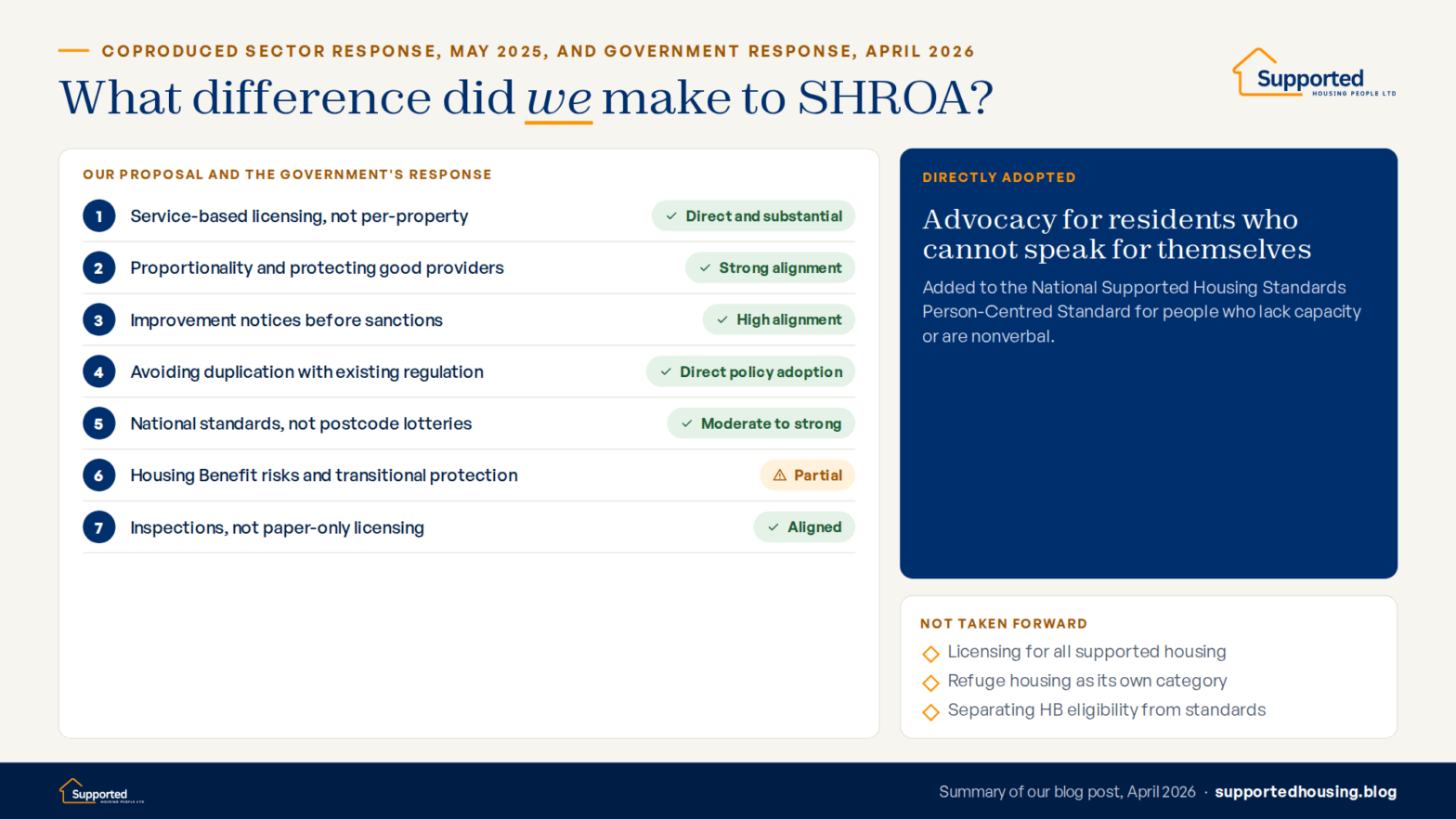
In our analysis, together we’ve made a significant difference to the government’s direction of travel in several key areas of SHROA. See below for the details, but the single most telling comment from the analysis, for us anyway, is:
“In several areas, especially licensing structure, the government’s final position reflects the same problem definition and solution logic found in the (SHP Consultation) response.”
One area that the AI analysis originally missed is the direct relationship between the SHP Consultation response and the National Supported Housing Standards (NSHS) (Person-Centred Standard) for people who lack capacity. The original NSHS didn’t address this, including the need for advocacy for people who lack capacity or are nonverbal.
I have to own up to some bias here, or is it recognition of lived experience? One of my sons, who will be a supported housing resident, is nonverbal and has been deemed to lack capacity within the meaning of the Mental Capacity Act 2005. It was people like him that I was thinking about when I raised the issue of the need for advocacy for people, like my son, in supported housing who cannot speak for themselves. This has been directly acknowledged and agreed upon by the government as an amendment to the NSHS Person-Centred Standard. And it wasn’t the only direct policy adoption from the SHP Template Consultation Response either.
The results are an absolute credit to the value of coordination and coproduction within the supported housing ecosystem. We have collectively made a massive difference to government policy on supported housing.
Thank you to everyone who contributed to the SHP co-produced SHROA Consultation response. The government’s own response is here for comparison.
1. Per‑property vs service‑based licensing
Your response
Repeated across Questions 25, 35, 52, 54, 71, 76, 86
Core argument:
- Defining a “scheme” by a single postal address is unworkable
- Dispersed services would face excessive multiple licences and DRPs
- Licensing should attach to the managing/controller entity and operate at the “service” level
Key phrases in your document:
- “Remove the reference to ‘a single postal address’”
- “Think in terms of a service, not a scheme”
- “Saturation licensing”
Government response
Section: ‘Revised Licensing Application Process’
The government explicitly abandons the per‑property model:
“The government has moved away from a per‑property application model… A licence must be obtained by the person managing or in control of supported housing properties in each licensing district.”
Nature of influence: ✅ Direct and substantial
This is one of the strongest examples of consultation feedback materially reshaping policy design.
2. Proportionality and protecting good providers
Your response
Woven throughout, especially Questions 8, 11, 18, 39, 56–66, 76–88
Key assertions:
- Regulation must not destabilise good services
- Enforcement should be improvement‑led
- Trauma‑informed practice and operational realities must be recognised
- Automatic escalation → service collapse risk
Government response
Ministerial Foreword and “Enforcement and Compliance” sections
“It is important that we protect the supply of good supported housing… these reforms must be both proportionate and sufficiently robust.” [gov.uk]
Also reflected in:
- Emphasis on improvement notices before revocation
- Risk‑based inspections
- Avoiding unnecessary service exit
Nature of influence: ✅ Strong philosophical alignment
3. Improvement notices before sanctions
Your response
Questions 56–67
You argue:
- Improvement plans must precede enforcement
- Revocation should be a last resort
- National guidance required to avoid arbitrary escalation
- Shared responsibility (managing agent, landlord, care partner) must be recognised
Government response
Section: ‘Enforcement Framework’
The response confirms:
- Use of improvement notices
- Graduated enforcement
- Sanctions reserved for serious or repeated non‑compliance
Nature of influence: ✅ High alignment
4. Avoiding duplication where other regulation already exists
Your response
Questions 36, 43, 44, 46
You argue that:
- Ofsted, MoJ, DA services, and commissioned care already have oversight
- Licensing should not duplicate existing robust regimes
- Exemptions must be carefully scoped but justified
Government response
Section: ‘Exemptions from Licensing’
Expanded exemptions now include:
- Ofsted‑regulated provision (up to 25)
- MoJ CAS2 schemes
- Domestic abuse services
- LA‑managed commissioned services
- Older people’s housing and almshouses
Nature of influence: ✅ Direct policy adoption
5. National standards with local flexibility (not postcode lotteries)
Your response
Questions 26, 47, 69, 70
You request:
- National standards and evidence expectations
- Avoidance of local variability
- Training, peer review, standardised tools
- National guidance with local application
Government response
Sections: ‘National Supported Housing Standards’ and ‘Role of Local Authorities’
Government confirms:
- Introduction of National Supported Housing Standards
- National framework with local delivery
- Guidance to promote consistency
Nature of influence: ✅ Moderate to strong alignment
6. Housing Benefit linkage risks and transitional protection
Your response
Questions 76–88
Key warnings:
- HB is already delayed and inconsistent
- Linking HB to licensing risks, cash‑flow collapse
- Providers must be treated as licensed during the application/appeal process
- Residents must not lose HB due to the local authority’s delay
Government response
Section: ‘Housing Benefit and Licensing’
Government confirms:
- Intention to link HB to licensing
- Recognition of transition risks
- Commitment to implementation safeguards, phased approach, and resident protection
Nature of influence: ⚠️ Partial
Risk acknowledged, but safeguards are less explicit than you proposed.
7. Use of inspections (not paper‑only licensing)
Your response
Questions 54–55
You argue:
- Licensing without inspection would undermine standards
- Paper‑based assessments are insufficient
- Inspections should occur at grant, variation, renewal, and when concerns arise
Government response
Sections: ‘Inspection Powers’
Government confirms:
- Power to inspect
- Risk‑based approach
- Inspections where needed rather than automatic desk‑based licensing
Nature of influence: ✅ Aligned
8. Issues not taken forward
| Your position | Government outcome |
|---|---|
| SHROA licensing should apply to all supported housing, not only SEA | Not adopted |
| Explicit recognition of refugee supported housing as a category | Not explicit |
| Full separation of HB eligibility from NSHS compliance | Not adopted |
These appear to be constrained by legislative scope and DWP policy limits rather than by a lack of persuasive argument.
Summary Judgement
Your consultation response aligns most strongly with government decisions on:
- ✅ Service‑based licensing
- ✅ Proportional enforcement
- ✅ Expanded exemptions
- ✅ National frameworks over postcode variation
- ✅ Improvement‑led regulation
- ✅ Advocacy for supported housing residents who lack capacity and/or the ability to verbally communicate as part of the Person-Centred NSHS Standard
In several areas, especially licensing structure, the government’s final position reflects the same problem definition and solution logic found in your paper. Proposals regarding the need for advocacy for people who lack capacity and for licensing exemptions for 3rd-party regulated services were directly adopted by the government.