
This Briefing is aimed primarily at English readers, although my observations on the uncertain future of Housing Benefit do have UK-wide applicability.
It is not written by AI.
The image is AI-generated. AI was used to verify/clarify some issues during research. The comparison at the foot of the Briefing was generated by AI.
Introduction
After a long wait, the Government has published its response to the consultation on the Supported Housing (Regulatory Oversight) Act, and it has clearly listened. The direction of travel is broadly positive. However, while there are real improvements, SHROA is not quite “there” yet.
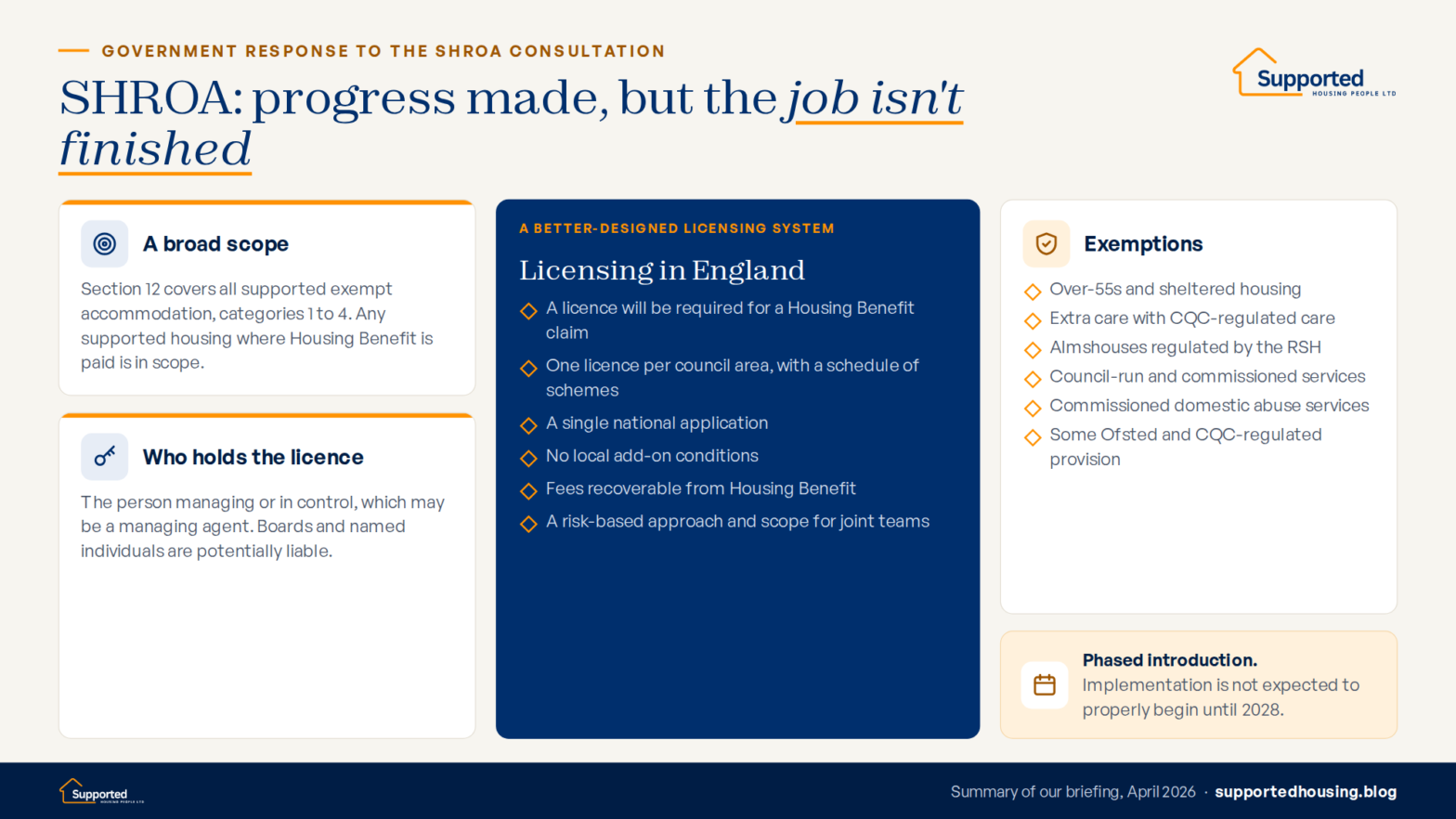
We shouldn’t now expect implementation of systems to properly begin until 2028.
Many of the gains secured in the final response can be traced back to the sector’s collective effort, particularly the Supported Housing People (SHP) consultation response template, which many providers and partners contributed to last year. That collaboration has paid dividends.
Crucially, SHROA will be introduced in phases, giving councils and providers time to prepare. It’s not clear whether there will be time for Pilots (critically important) or for councils to learn from their peers by examining good practice models, such as Hull Council’s SART team.
What counts as supported housing?
The Act confirms a broad definition of “supported housing” in section 12. It aligns with the established understanding of Supported Exempt Accommodation (SEA) as a whole and is not limited to Exempt Accommodation (Specified Accommodation Category 1). Categories 2, 3 and 4, managed property, refuges without CSS and local authority hostels, are also included.
In practice, this means any supported housing where Housing Benefit is paid is within scope, although certain council‑run and commissioned services are exempt and will need further clarification in guidance. This includes Specified Accommodation Category 4 (Local Authority Hostels). See the full list below.
Licensing: a better‑designed system
A Supported Housing Licence will be required for an HB claim in England. Councils will take a risk-based approach to Licensing, focusing on those supported housing services they’re most concerned about.
Licence fees will be recoverable from Housing Benefit, reducing the financial impact on providers.
Licensing will apply to “the person managing or in control of supported housing”, rather than defaulting to the landlord. In agency‑managed services, this may be the managing agent, a marked departure from the original consultation, which would have tied landlord licences to agent compliance. That approach has been changed in favour of an approach that says, “do what’s right on the ground”, and this should be done with regard to case law and guidance.
Please see my comments below regarding agency-managed services, particularly when third-party CSS is provided. SHROA intersects with HB a lot, and there may be consequences for Specified Accommodation designations if we get the Licence-holder wrong.
There will be one licence per local authority area, with a schedule of schemes attached. Schemes can be removed if they are non‑compliant, and licences may be revoked where the holder is no longer considered fit and proper.
There will also be:
- A single national licence application
- No local add‑on licensing conditions
- Scope for councils to operate joint licensing teams
If an organisation holds a Supported Housing Licence, its Board of Directors will be potentially liable for any failure of compliance, as will any named individual.
Who will run licensing?
The licensing authority will sit within council housing departments and is expected to operate on a multidisciplinary basis, drawing on housing, revenues and benefits, planning, environmental health and social services.
This should be relatively straightforward in unitary authorities. In shire counties, however, responsibilities remain split across tiers. SHROA therefore requires cross‑authority liaison, a necessary provision while the future of shire counties remains uncertain under the government’s reorganisation agenda.
This is especially an issue with Social Services commissioning care providers without sufficient due diligence, who will then demand HB in circumstances where revenues and benefits colleagues might question aspects of that provider’s appropriateness for HB and SEA compliance.
I have previously made the point that 5-year Supported Housing Strategies should consider these care providers rather than disregard them as “not SEA”. The problem is that they will force their way into the supported housing ecosystem, as they are doing now, through the back door because of a lack of coordination.
Tackling “entryism”
SHROA is clearly aimed at addressing one of the sector’s most persistent problems: entryism.
We continue to see property‑led operators and private care providers exploiting weak system interfaces, particularly poor liaison between social care commissioners and revenues and benefits teams. Some actors who previously set up CICs to extract Housing Benefit have simply rebranded as “commissioned care providers”, using commissioning pressure to secure HB payments.
SHROA should not be necessary to prevent this behaviour, but in the absence of effective system alignment, it may finally provide the tools to do so. We shall see.
A tougher Fit and Proper Person Test
The strengthened Fit and Proper Person Test (FPPT) is another welcome change. Rather than resembling HMO licensing, it will be more closely aligned with CQC and Ofsted standards, focusing on integrity, competence and experience.
This clearly targets providers with no emotional commitment to supported housing, those who overcrowd properties, strip out communal space, and justify the denial of communal facilities as “antisocial behaviour management”. While the National Supported Housing Standards (NSHS) should have gone further in mandating communal space, the intent here is unmistakable.
The FPPT also extends to a requirement to ensure that “Service Managers” who manage supported housing are named on Licence applications and are thoroughly vetted by the Licence applicant.
Exemptions: necessary, but risky
SHROA introduces a significant number of licensing exemptions, particularly for:
- Over‑55s and sheltered housing (so-called “low support supported housing”)
- Extra care with CQC‑regulated care
- Almshouses regulated by the RSH
- Council‑run and commissioned services
- Domestic abuse services commissioned under the Domestic Abuse Act (S.4)
- Certain Ofsted‑regulated and CQC‑regulated provision
The rationale is to reduce duplication of oversight, which is sensible. However, there is a risk that “low support” becomes conflated with “low cost”. As residents’ needs increase over time, services may become under‑resourced, and councils will need to actively monitor whether licensing should apply.
Agency‑managed services and Housing Benefit risk
A complex and consequential issue is how SHROA interacts with agency‑managed supported housing, including IHM‑only models and schemes with third‑party commissioned care. An area where SHROA and HB intersect.
Licence ownership matters. It may influence whether a scheme is treated as Exempt Accommodation or Managed Property, with significant negative revenue implications if the latter. Where landlords provide intensive housing management and maintenance at a more‑than‑minimal level, or agents do so on their behalf, the case law is clear: this can and often does amount to “support and supervision” of a “more than minimal” degree. This makes the supported housing Exempt Accommodation, not Managed Property. Notwithstanding this, if the landlord is seen to be at a remove from the support provider by not holding the Licence, we could be tempting fate.
Landlords and agents will need to think carefully about who holds the licence, how management and control are evidenced, and how that position will be interpreted by revenues and benefits teams.
Commissioned services and standards
Commissioned support services will not be subject to NSHS compliance as a licensing condition. They are already regulated. Responsibility for meeting support standards in these schemes will sit with commissioners, not licence holders, though licence holders must flag concerns to the licensing authority.
No new housing standards, but higher expectations
SHROA does not introduce new housing standards. Licensed schemes must meet existing requirements such as the Decent Homes Standard and HHSRS.
What will change is expectation and scrutiny. Collaborative initiatives like the Exempt Accommodation Project (EAP) already demonstrate what is possible: improved quality, stronger partnerships, and very substantial subsidy savings for councils, delivered at no cost to providers or local authorities.
No review of CSS and housing benefit will be abolished
The government has kicked the can down the road on the redefinition of CSS because it will be abolishing Housing Benefit, as I predicted last year.
The government still reinforces the fiction that CSS is ineligible for HB funding in circumstances where case law holds that Intensive Housing Management and Maintenance, which are HB-eligible, constitute “support and supervision”.
I predict significant pressure on HB claims until HB is abolished, probably after the lifetime of this parliament. IHM-only and agency-managed services, with or without third-party personal support and/or care, are especially interesting in this regard.
Local Need and Statement of Purpose standards softened
The Local Need Standard is clarified to exclude a local connection test. This is a restatement of the current position in which a claim for HB in supported housing doesn’t require a local connection. Going forward, however, providers will need to give councils a “rationale” for accepting residents with no local connection.
New providers only need to evidence compliance once local supported housing strategies are published. This gives the property-led entryists time to make hay while the sun shines, unfortunately. These are the people with no emotional commitment to supported housing who will probably never comply with Licensing or the NSHS and may be a major headache for councils when they’re defunded, especially if they operate at size as many do.
The Statement of Purpose no longer requires publication of scheme location details to protect resident safety.
Where does this leave us?
The government’s position is a substantial step forward. The proposed shape of SHROA is more proportionate, better designed, and more informed by sector expertise than the original proposals. But risks remain, particularly regarding exemptions, agency‑managed models, and the interpretation of Housing Benefit.
The challenge now is implementation. If SHROA is applied intelligently, it can raise standards without damaging good provision. If not, it risks reinforcing existing misunderstandings rather than resolving them.
What the Consultation doesn’t acknowledge, or address, is the systemic problems with the supported housing ecosystem: funding uncertainty for both revenue and capital, and the availability of low-cost, good-quality housing for move-on.
The framework is better. The outcome will depend on how well we use it.
Events
Supported Housing People is running a series of events in May and June on the Government’s Response to SHROA.
Book your tickets here: https://www.tickettailor.com/events/supportedhousingpeopleltd
Below is a clear before‑and‑after comparison table showing how the Government’s final SHROA consultation response differs from the original consultation proposals (closed May 2025).
The focus is on substantive policy changes and clarifications, not restating unchanged elements.
SHROA: Before and After Comparison
| Policy Area | Original Consultation (May 2025) | Government Response (Final Position) | What Changed / Why It Matters |
|---|---|---|---|
| Overall approach | Strong enforcement‑led tone focused on tackling abuse | More balanced, proportionate, risk‑based approach | Signals intent to regulate bad practice without destabilising good provision |
| Implementation | Limited detail on timing | Phased introduction confirmed | Reduces immediate risk and allows councils/providers to prepare |
| Who must hold a licence | Default assumption that the landlord would hold the licence | Licence applies to “the person managing or in control” | Major redesign; aligns licensing with actual control, especially in agency‑managed models (but risky!) |
| Agency‑managed supported housing | Landlord licence dependent on agent compliance with NSHS | Parties decide who holds the licence based on control and case law | More pragmatic. Choice should reflect operational reality |
| Number of licences | Ambiguous; risk of scheme‑by‑scheme licensing | One licence per council area with a schedule of schemes | Councils are empowered to operate joint licensing teams |
| Treatment of non‑compliant schemes | Not clearly specified | Schemes can be removed from licence schedules | Enables targeted enforcement without shutting down entire providers |
| Licensing application | Local discretion implied | Single national application, no local add‑on conditions | Prevents postcode regulation and inconsistency |
| Joint working by councils | Not explicit | Proposed, but with limited clarity | Supports capacity‑building and consistency |
| Licensing authority | Not fully defined | Council housing department confirmed as Licensing Authority | Clarifies accountability and organisational location |
| Fit and Proper Person Test (FPPT) | Modelled loosely on HMO licensing | Much more stringent, aligned with CQC/Ofsted | Raises the bar on integrity, competence and experience |
| Who FPPT applies to | Licence holder only | Applies to boards, partners, and (for vulnerable services) service managers | Directly targets entryist and exploitative actors |
| Regulatory overlap (CQC) | Potential ambiguity | CQC limited to regulated personal care only | Avoids duplication and regulatory confusion |
| National Supported Housing Standards (NSHS) | Proposed but with limited clarity | Confirmed; underpin licensing, but with softened application | Retained, but more proportionate. Still lack PIE and TIA focus |
| Commissioned support services | Risk of licence holders being accountable | Licence holders not responsible for commissioned support quality | Clarifies accountability between providers and commissioners |
| Role of commissioners | Not clearly stated | Commissioners expected to commission support compliant with NSHS | Shifts responsibility to where it properly sits |
| Local Need Standard | Risk of acting as a local connection test | Explicitly not a local connection test | Protects mobility and specialist provision |
| New providers & local need | Immediate compliance expected | Compliance required once local strategies exist | Lowers entry barriers for providers. That isn’t all good news if you’re concerned about “entryism” |
| Statement of Purpose | Required location details | Location details removed | Improves resident safety |
| Licensing exemptions | Limited clarity | Significant exemptions confirmed (e.g. low support, RSH/CQC/Ofsted‑regulated, council‑run services) | Introduces proportionality but creates implementation risk |
| Low‑support services | Not clearly addressed | Explicitly referenced (e.g. over‑55s, sheltered housing) | Clarifies intent but risks under‑resourcing as needs increase |
| Housing standards | Risk of new standards being introduced | No new housing standards; existing regimes apply | Avoids duplication of housing law |
| Licence fees | Cost implications unclear | Recoverable from Housing Benefit | Removes a financial disincentive to compliance |
Headline takeaway
- Core architecture unchanged: licensing, standards, and local authority oversight remain.
- Design significantly improved: licensing structure, accountability, and proportionality are materially better.
- Key risks remain: exemptions, agency‑managed models, and the interpretation of Housing Benefit will depend heavily on guidance, case law and local implementation.
This is the most useful summary of changes from start of consultation to the Act coming into force. I have a meeting coming up with a Council and feel more informed attending the meeting. Thank you
Hi Beverley, you’re welcome. We’re looking at additional venues. Could you get to Hull?
Thank you, really good briefing.
You’re welcome Paula, thanks for your kind comments.
Thanks for a great briefing and analysis.