
What’s the Difference between Intensive Housing Management and Maintenance, and “Care, Support or Supervision”?
Introduction
Almost exactly a year ago, I published a blog post entitled “What is Care, Support or Supervision and can it be Funded Through Enhanced Housing Benefit”. This was published at the same time as the Supported Housing Regulatory Oversight Act (SHROA) Consultation was underway, and my intention was to influence the DWP’s work on redefining “Care, Support or Supervision” (CSS) as part of SHROA. We still await the DWP’s deliberations on this as per my Briefing of December 2025.
My position was and remains the case that certain types of “support and “supervision” are HB-eligible because case law says that to be so, and it therefore cannot follow that “CSS is ineligible to be funded by housing benefit”, with the obvious exception of “care”, which has its own statutory definition.
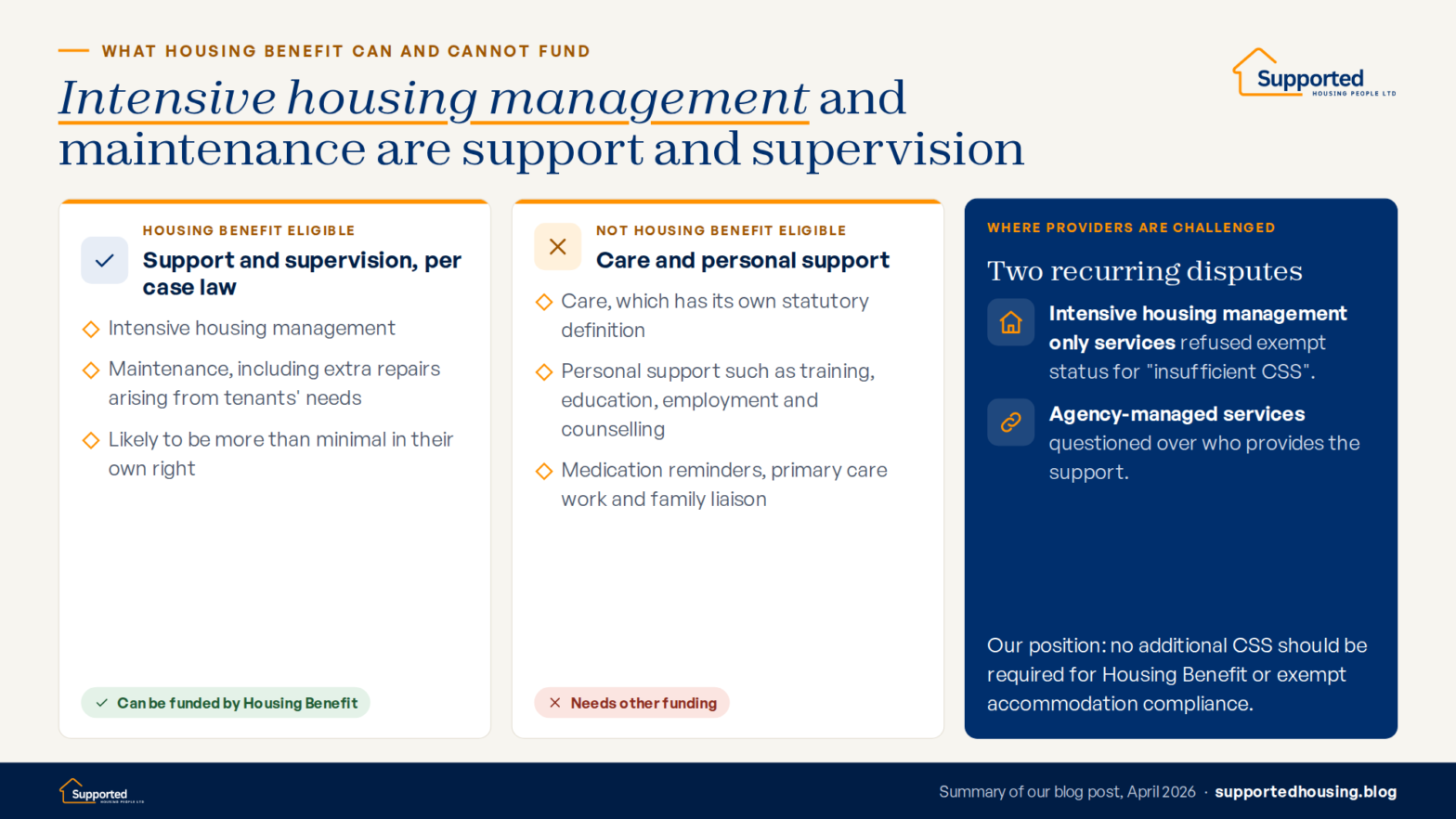
In other words, Intensive Housing Management and Maintenance are “Support and Supervision”. Intensive Housing Management and maintenance are likely to be “more than minimal”, and there should be no requirement to provide additional CSS for the purposes of housing benefit or exempt accommodation compliance.
To be clear, “care” and “personal support” are not eligible to be funded by housing benefit. However, case law accepts that Intensive Housing Management and Maintenance are “Support and Supervision”.
The position of the DWP, and often of revenues and benefits colleagues, is, however, that CSS is not eligible for funding through housing benefit. As I wrote at the time:
“The’ care, support or supervision’ is not eligible to be funded through enhanced housing benefit” position is based on regulation 10 of the 1987 Housing Benefit regulations and Schedule 1 of the 2006 Housing Benefit Regulations. The problem is that the meaning of “support” and “supervision” has evolved over time through case law. The Housing Benefit Regulations haven’t done so in the same sense.”
Why This Matters
Since publishing that blog post, I have spent considerable time working with supported housing providers who have been consistently challenged by both SHIP Teams and Revenues and Benefits Teams in two key areas:
- So-called “intensive housing management only” supported housing
- Agency-managed supported housing
Intensive Housing Management Only Supported Housing
One of the unfortunate consequences of the incorrect view that “CSS” is not eligible to be funded through housing benefit is that very good supported housing services are being denied Supported Exempt Accommodation (SEA) status and their residents denied housing benefit, or closed because SHIP or Revenues and Benefits teams are of the incorrect view that “insufficient CSS” is being provided. This is in circumstances where people with significant levels of additional needs are receiving an intensive housing management and maintenance service, but often no recorded “non-HB eligible support” (training, education, employment, counselling, work with primary care, medication reminders, family liaison, etc.). When this is provided, it often isn’t recorded by the provider because no one funds them to provide these services.
Some providers evidence non-HB-eligible services that they subsidise internally and are often required by councils to demonstrate how they provide this subsidy (which they shouldn’t have to provide at all).
Other providers charge tenants for a nominal/notional “support” service. Usually, this is done by adding £15 or thereabouts to the weekly ineligible charge. They do this to try to satisfy a completely unreasonable demand that they provide evidence of the provision of non-HB-eligible support. The payment for this unreasonable demand, in these circumstances, is either from the provider from their own resources or from the resident from their own resources. Neither situation is acceptable. Housing benefit is a personal welfare benefit entitlement.
If supported housing residents are having their entitlements compulsorily docked to fulfil a spurious requirement, even when the council believes it is acting in good faith, this is more than serious.
It is also in circumstances where the DWP Guidance on Housing Benefit Claims for Supported Housing specifically states in paragraph 151 that “there is no set number of hours that must be provided for the care, support or supervision to be sufficient”, and where case law that states “a satisfactory test for determining whether support of more than a minimal amount is provided is to ask whether the support provided was likely to make a real difference to the Claimant’s ability to live in the Property” (CH/200/2009). In considering this, we should bear in mind that IHM is support and supervision.
The fact is that in terms of the case law CH/150/2007 and CH/4432/2006, both imply that Intensive Housing Management and Maintenance is “support” in the context of exempt accommodation and is fundable by enhanced Housing Benefit. The following case law references are expanded in the case law digests at the end of this Briefing.
CH/4432/2006 states “….repairs can, if required with sufficient intensity, amount to support”.
CH/779/2007 (reported as R(H) 6/08) says “In the case of “support”, it may be that the making available of certain types of service itself amounts to the provision of “support” within the meaning of exempt accommodation”. REG 12(8) of the Housing Benefit regulations 2006 says “services” means services performed or facilities (including the use of furniture) provided for, or rights made available to the occupier of a dwelling.
So, “support” would include more intensive maintenance, repair and replacement of furniture, fixtures, and white goods.
Chorley BC v IT [2009] UKUT 107 (AAC), [2010] AACR 2 (CH/150/2007) implies that Intensive Housing Management is “support” in the context of exempt accommodation and is fundable by Housing Benefit.
I should also make the point that not all support and supervision, as defined by case law, is quantifiable in terms of staff hours. How do you “quantify” intensive maintenance in terms of staff hours, for example? It is “support” because the case law says so, and this should be made clear when negotiating HB claims.
You may be aware that there is currently a “de facto” de minimis rule that states that 2-3 hours of CSS per week per person on average would meet the “de minimis” threshold (i.e., the minimum amount of CSS that must be provided per person per week on average). This isn’t true, based on what I have written above and the case law schedule that forms much of this Briefing below.
It is based on a loose interpretation of case law, which states that three hours a week of care, support, or supervision may be more than minimal (CH/1289/2007, para 21), but 10 minutes a week will not be (R(H) 7/07, paras 29 and 30). It does not form any part of regulation or guidance, and it doesn’t acknowledge those parts of case law that clarify what “support” and “supervision” are. Concierge and “out of hours” services usually have a very prominent “supervision” component.
So, if you’re involved with a so-called IHM-only supported housing service that has been challenged in this way, please contact us because the case law is on your side. (“So-called IHM” because they often do more than HB-eligible support but don’t record it).
Bear in mind that exempt status applies to a claim, not a building, and applies on the basis that the resident has CSS needs that are “more than minimal”. The above and below case law should give you what you need to manage the “more than minimal” minefield. It may legitimately be the case that some buildings accommodate both Universal Credit claimants and Housing Benefit claimants.
You do not have to show that you are providing non-HB-eligible support to meet the “more than minimal” threshold. You CERTAINLY shouldn’t charge the costs of non-HB-eligible support to residents to attempt to comply with a non-existent requirement.
The purpose of this opinion is not to be critical of SHIP Teams and Revenues and Benefits colleagues; I work closely with the latter in particular. In circumstances where the supported housing provider genuinely isn’t doing enough to make a difference or is just an investor or property outfit masquerading as a supported housing provider, we won’t help them because those are the supported housing schemes that SHIP Teams and Revenues and Benefits teams need to be focusing on and to the extent that those teams need my help in ridding the supported housing ecosystem of supported housing opportunists I would be only too pleased to help.
Agency-Managed Supported Housing
Another area of housing benefit consultancy work I have been involved in over the past year is with registered provider (RP) owned supported housing managed by specialist supported housing agencies.
These supported housing schemes can either be categorised as Specified Exempt Accommodation Category One (exempt accommodation) or Specified Exempt Accommodation Category Two (managed property).
For an agency-managed service to be classed as exempt accommodation, the RP landlord must have a Management Agreement with the agent that identifies the IHM services the agent provides on the landlord’s behalf.
Aside from that, the same case law principles that apply to the so-called “IHM only” schemes should also apply to agency-managed supported housing, which can be “IHM only” or with third-party CSS provided by the agent on behalf of a council or the NHS, for example.
It is too often the case that Revenues and Benefits teams assume that an agency-managed scheme with third-party CSS is automatically Specified Exempt Accommodation Category Two (managed property) because much of the CSS is provided on behalf of the council/NHS rather than the landlord. If that’s all there is to it, and the landlord, and/or the agent on the landlord’s behalf does nothing more that general needs housing management and maintenance in addition to third-party CSS, then it’s probably Specified Exempt Accommodation Category Two (managed property).
However, many agency-managed supported housing services provide both third-party CSS and IHM. Where that IHM is provided by the landlord, by the agent on behalf of the landlord, or both and is of “sufficient intensity” to make a genuine difference to the ability of the tenant to live there, then it’s Specified Exempt Accommodation Category One (exempt accommodation).
Why does this matter?
If a supported housing scheme is classed as Category Two instead of Category One, the main disadvantages are:
- Rents are less protected: Category Two schemes are more likely to have rents reduced or challenged by the council.
- More arguments and scrutiny from the council: Councils look much harder at Category Two schemes and often question whether costs are reasonable.
- Greater financial pressure on councils: Councils usually recover less Housing Benefit subsidy for Category Two, so they are more hostile to higher rents, and more likely to attempt to restrict to LHA levels.
- Harder to defend at tribunal: You start in a weaker legal position and must explain why the rent is high if the landlord doesn’t provide the third-party CSS, and also justify the IHM provided as “support and supervision”.
- Less recognition of intensive housing management: Costs for things like extra repairs, inspections, tenancy sustainment, and supervision are more likely to be cut back.
There is also a significant risk to Category Two schemes from SHROA. Although the Act broadly regulates supported exempt accommodation, Category One schemes are the policy reference point.
Category Two supported housing is more likely to be targeted as:
- The provision of IHM may be assumed to be less than minimal when it isn’t
- These schemes are perceived as having less clear accountabilities, where the landlord is different from the CSS provider
- There is also a higher chance of:
- SHROA “Inspection” challenges where the scheme remains specified accommodation, but is insufficiently resourced to comply with the National Supported Housing Standards and/or Licensing
- Local authority re‑designation pressure, which exists already.
Given the large number of private sector care providers trying to access housing benefit by taking commissioned care packages from Adult Social Care departments (who often do insufficient due diligence on those providers), it might be more sensible to expand the scope of the SHROA 5 year Supported Housing Strategies currently being developed by councils to include these services before they get to the point of claiming HB.
Comparison Table: Protections Afforded to Exempt Accommodation (Category One) Versus Agency-Managed (When Defined as Category Two)
| Issue | Cat 1: Exempt Accommodation | Cat 2: Managed Property |
| Rent protection | ✅ Strong | ⚠️ Weaker |
| LA subsidy | ✅ Better | ❌ Worse |
| Tribunal footing | ✅ Favourable | ❌ Defensive |
| Scrutiny intensity | ✅ Lower | ❌ Higher |
| Regulatory resilience | ✅ Strong | ⚠️ Moderate |
| Evidence burden | ✅ Shared | ❌ Landlord‑heavy |
| Long‑term viability | ✅ Stable | ⚠️ Fragile |
Unreasonable Demands for Information
In my experience, most Revenues and Benefits Teams manage housing benefit claims professionally and reasonably and have a really challenging job in trying to sort out the supported housing ecosystem’s goats from its sheep without simultaneously throwing the baby out with the bathwater. They continue to have to do this whilst the whole sector waits and waits for SHROA, which, theoretically, should make that job easier.
However, I am encountering increasingly demanding information requests from some councils to supported housing providers.
At the most basic level, councils can require information on the following:
- Evidence of care, support or supervision (CSS)
- Proof of the accommodation type and landlord status
- The rent breakdown and eligible service charges
- Link between support and occupying the accommodation (i.e. does continued occupancy depend on receiving CSS?)
- Basic governance and delivery arrangements
- Conflicts of commercial interest in lease-based supported housing
And that a claimant must: “…furnish such certificates, documents, information and evidence in connection with the claim or the award of benefit as may be reasonably required by the relevant authority.”
Regulation 86(1) of the Housing Benefit Regulations 2006 states that:
- Local authorities may only request information that is “reasonably required” to determine a claim.
- Overreaching requests (e.g., demanding evidence that it is unreasonable to expect a claimant or landlord to provide) can be unlawful.
“Overreaching requests” would, in my view, include demands for financial and other data of such detail and granularity as to be impractical for the supported housing provider to produce, acting reasonably.
Conclusion
In summary, the law is clear that Intensive Housing Management and Maintenance can and does constitute “support and supervision” for Housing Benefit purposes.
Case law consistently confirms that where intensive housing management, repairs, maintenance, concierge/on call are provided with sufficient intensity to make a real difference to a person’s ability to live in their home, they meet the “more than minimal” threshold required for exempt accommodation.
The common error, by councils and providers alike, is to treat “(care,) support or supervision” as requiring additional, non-HB-eligible personal support or a minimum number of staff hours. Neither regulation nor case law supports that view. Properly evidenced IHM‑led schemes, including agency‑managed services where IHM is provided by or on behalf of the landlord, can and should qualify as Category One (Exempt Accommodation). Misclassifying them as Category Two weakens rent protection, increases the risk of challenges, and is not required by law.
If you’re involved in supported housing and you need help with this, please contact us.
A Few Words About AI
We use AI within SHP quite widely. Lots of people do. We use it to simplify tasks, especially when we’re researching things. We’re also very careful with it. It’s only as good as the framing of our questions, and its output should always be verified.
We’re also mindful that if we ask AI for data or positions on supported housing, it will often cite my published work, amongst a few others, as justification for its conclusions, which is a bit like me “marking my own work”. As someone with an academic background, I want my ideas to be peer-reviewed (and not copied without acknowledgement either!).
We have all recently seen a veritable tsunami of rapidly produced technical guidance on supported housing and everything else you can think of. Some is truly, dangerously dreadful, and some is very good.
AI is not always easy to spot, but if, like me, you have spent quite some time in recent years assessing undergraduate and postgraduate social work essay drafts in a supervisory capacity, then you get good at spotting it even without using AI detection tools.
The point I want to make here is that the use of AI should be declared in documents by the researcher/curator of that document, along the lines of “This document was drafted with the assistance of AI tools and reviewed by the author, who takes full responsibility for its content.”
No author should assume their readers know they’re reading AI-generated material, and no author should give the impression that AI-generated material is their own voice, even by omission.
For the record, most of what you get from me is my own voice and my own thinking and deductions. AI isn’t passionate. I am.
In this document, all content preceding this point is not AI, except for the image, the Category One and Category Two comparison table, and the conclusion. The conclusion is an AI summary of my own words, not those of CoPilot, Chat GPT or any other AI. I have used AI to research and triangulate some data, as I often do.
AI is very useful, but it is also subject to etiquette and integrity considerations.
From this perspective, I have used AI to curate the case law summary below, which I hope will be helpful to IHM-only and Agency-Managed supported housing services in fighting their corner when seeking Supported Exempt Accommodation status as Category One Specified Accommodation (exempt accommodation) services.
A comprehensive, AI-Generated, humanly verified UK‑focused case‑law digest identifying Housing Benefit tribunal and Upper Tribunal (AAC) authorities which explicitly or implicitly recognise “intensive housing management and maintenance” as capable of amounting to “support or supervision” for the purposes of exempt accommodation / specified accommodation and eligible service charges.
Important framing point
UK courts and tribunals do not use the label “intensive housing management” as a statutory term. Instead, they assess what the landlord actually does. Case law shows that housing management and maintenance functions, when delivered at enhanced intensity because of the claimant’s vulnerabilities, can amount to support or supervision rather than ordinary landlord functions.
1. CH/200/2009 – Bristol City Council v AW
(Judge Turnbull, Upper Tribunal / Commissioner)
Key principle
Support exists where landlord activity is likely to make a real difference to the claimant’s ability to live in the property, even if it resembles housing management.
Relevance to intensive housing management
Judge Turnbull confirmed that:
- Housing-related functions can constitute “support”
- The question is intensity, purpose, and impact, not labels
- Support must be more than minimal, but need not be personal care
This case is repeatedly cited to justify intensive housing management packages, including tenancy sustainment and maintenance-related interventions aimed at vulnerable tenants rather than at the building itself.
2. R(H) 2/07 – CH/423/2006
(Social Security Commissioner)
Key principle
Supported accommodation is accommodation in which:
“a measure of care, support or supervision is provided to assist the occupants to cope with the practicalities of day-to-day living.” (para 2)
The fuller definition of support, “the giving of advice and assistance to the claimant in coping with the practicalities of everyday life”, came later, in CH/779/2007 (reported as R(H) 4/09), para 232.
Relevance to maintenance and management
This case explicitly recognised that:
- Support does not need to be care
- Assistance with living independently may qualify
- Practical help linked to managing a home may be support, depending on the context
This is a foundation authority later used to justify enhanced landlord involvement in repairs, property condition, and tenancy sustainment for vulnerable tenants
3. R(H) 7/07 – CH/3811/2006
(Commissioner Turnbull)
Key principle
Landlord-provided support can count even when the landlord also performs housing management roles, provided it goes beyond ordinary functions.
Relevance to intensive housing management
The Commissioner held that:
- Landlord activity beyond “general needs” norms may constitute support
- Routine landlord tasks can become support if delivered in response to tenants’ particular needs
- The dividing line is function plus context
Although the appeal failed on facts, the legal principle underpins intensive housing management claims, including maintenance exceeding normal standards
4. Chorley BC v IT
[2009] UKUT 107 (AAC), [2010] AACR 2, CH/150/2007
Key principle
The Upper Tribunal accepted that repairs and maintenance functions can themselves amount to support.
Direct relevance
This is one of the clearest authorities supporting this question.
The Tribunal explicitly considered:
- Whether “undertaking repairs and maintenance” could itself be the provision of support
- It confirmed that, in appropriate circumstances, it can
This authority is frequently cited where:
- Tenants cannot safely undertake minor repairs
- The landlord undertakes additional visits, checks, adaptations, or remedial works because of vulnerability
- In addition, the more intensive nature of supported housing maintenance amounts to “support”
5. Allerdale BC v JD & Others
[2019] UKUT 304 (AAC)
Key principles
- Intensive housing management is not automatically “support”, but neither is it automatically excluded
- The assessment must examine what each element actually does
- The context of tenant disability or vulnerability raises the likelihood that housing management functions are supportive
- This gives a proper basis for the apportionment of charges
Relevance to intensive management and maintenance
Judge Ward accepted that:
- Activities such as repairs coordination, enhanced inspections, tenant liaison, and benefits assistance can form part of legitimate housing management
- Where those functions respond to tenants’ inability to manage housing issues, they may exceed ordinary landlord activity
Although part of the charge was disallowed, the decision affirmed the conceptual overlap between intensive management and support
6. R(H) 4/09
(Often cited alongside R(H) 7/07)
Key principle
- Availability and responsiveness of landlord staff can contribute to support and supervision
- Support and supervision may be delivered reactively (e.g. emergency interventions)
Relevance to housing management
This has been used to justify:
- Enhanced out‑of‑hours response (Concierge)
- Repeated landlord attendance to address problems affecting tenancy sustainment
- Preventive maintenance to avoid harm or tenancy failure
7. CH/4432/2006 – Chorley BC v EM
([2009] UKUT 108 (AAC))
Key principle
Support must be assessed with reference to what the landlord actually does differently from a general-needs landlord.
Relevance
This case underpins decisions accepting:
- Higher frequency inspections
- Ongoing remedial works
- Interventions where tenants cannot maintain habitability
Collectively, these activities are commonly classified as intensive housing management, where vulnerability is evidenced
8. Later Tribunal Practice and Guidance (Reflecting Case Law)
While not binding case law, tribunals frequently rely on:
- Judicial reasoning flowing from CH/200/2009, R(H) 7/07, and Allerdale
The guidance explicitly acknowledges that:
- Property-related tasks (repairs, adaptations, inspections)
- When delivered at enhanced intensity due to tenant needs can be HB‑eligible and linked to exempt accommodation principles
Consolidated Legal Rule from the Case Law
Across the tribunal authorities:
✅ Yes — intensive housing management and maintenance can amount to “support or supervision” where:
- The tenant’s needs require enhanced landlord intervention
- Tasks exceed what a reasonable general needs landlord would provide
- The functions enable the tenant to live in the accommodation
- The activity is directed at the person, not merely the building
❌ No — where:
- Activities are indistinguishable from ordinary landlord obligations
- There is no evidence of vulnerability-driven intensity
- The work is purely asset management rather than tenancy sustainment
Below is a case law–to–function mapping showing which specific intensive housing management (IHM) activities UK Housing Benefit tribunals have accepted can amount to “support or supervision”, why, and where the legal boundary lies.
This is written so it can be lifted directly into submissions, schedules of eligible services, or tribunal skeleton arguments.
Mapping Case Law to Intensive Housing Management Functions
1. Tenancy Sustainment & Crisis Intervention
(rent breaches, antisocial behaviour, relapse risk, safeguarding)
Accepted IHM functions
- Repeated landlord attendance to prevent tenancy failure
- De-escalation of disputes before formal enforcement
- Liaison with probation, mental health, or addiction services
- Early intervention instead of eviction paths
Case law authority
CH/200/2009 (Bristol CC v AW)
✔ Support exists where landlord activity is “likely to make a real difference to the claimant’s ability to live in the property”.
✔ Preventing tenancy breakdown = support, even if non‑care.
R(H) 4/09 (CH/779/2007), para 232
✔ Support includes assistance with the practicalities of everyday life, not merely care.
Practical effect
➡ Tenancy sustainment work is support where the tenant cannot independently manage risk.
2. Enhanced Repairs & Maintenance (Beyond General Needs Standard)
Accepted IHM functions
- Carrying out minor repairs that tenants would normally do themselves
- Proactive repairs to prevent deterioration affecting vulnerable tenants
- Repeated visits to deal with hoarding, damage linked to illness, or neglect
- Fast‑track or out‑of‑hours repairs for vulnerable residents
Case‑law authority
Chorley BC v IT [2009] UKUT 107 (AAC)
✔ The Upper Tribunal confirmed that undertaking repairs and maintenance can itself amount to the provision of support.
R(H) 7/07
✔ Landlord actions exceeding normal housing management can be support when delivered because of tenant need.
Allerdale BC v JD [2019] UKUT 304 (AAC)
✔ Housing‑management functions are not excluded from support if intensity is driven by vulnerability.
Practical effect
➡ Repairs become support when carried out because the tenant cannot safely maintain their home.
3. Frequent Inspections & Property Oversight
Accepted IHM functions
- Increased inspection frequency due to vulnerability
- Monitoring cleanliness, hazards, and infestations linked to mental health
- Environmental checks to ensure habitability (not asset protection)
Case‑law authority
Chorley BC v EM [2009] UKUT 108 (AAC)
✔ Support assessed by whether the landlord acts differently from a general‑needs landlord.
CH/200/2009
✔ Ongoing, preventive intervention may amount to support if it enables occupation.
Practical effect
➡ Inspections are support where they replace tenant capacity, not where they serve asset management alone.
4. 24/7 Availability, Emergency Response, and On‑Call Functions
Accepted IHM functions
- Emergency call‑outs
- Crisis attendance following alarms, welfare alerts, or neighbour reports
- Reactive landlord presence where the tenant cannot cope alone
Case‑law authority
R(H) 4/09
✔ Availability itself can contribute to support
✔ Support may be reactive, not scheduled
R(H) 6/08 (CH/779/2007, interim decision), para 21, quoted in Bristol CC v AW [2009] UKUT 109 (AAC), para 44
✔ Making support available, such as a properly staffed on-call or telephone service, can be providing support, whether or not the tenant uses it in a given period, where there is a real prospect the tenant will find it of use from time to time
Practical effect
➡ On‑call landlord functions may be supervision or support, where they replace self‑management capacity.
5. Managing Hoarding, Damage, or Poor Living Conditions Linked to Disability
Accepted IHM functions
- Coordinating clean‑ups or specialist contractors
- Supervising remedial works due to incapacity
- Ongoing monitoring post‑works
Case‑law authority
CH/200/2009
✔ Support assessed by impact, not description
✔ Sustained landlord input addressing functional difficulties counts as support
Chorley BC v IT
✔ Physical works undertaken due to disability can be supportive
Practical effect
➡ Maintenance + supervision + vulnerability = support.
6. Benefits Assistance & Financial Housing Stability (Housing‑Related Elements)
Accepted IHM functions
- Helping tenants claim HB correctly where cognitive impairment exists
- Liaising with councils to prevent rent arrears
- Preventing eviction through benefits management
Case‑law authority
Allerdale BC v JD [2019] UKUT 304
✔ Benefits assistance can be partly housing‑management, partly support
✔ Context of tenant disability increases the eligible proportion
CH/200/2009
✔ Assistance enabling occupation qualifies where it makes a real difference
Practical effect
➡ Benefits work = support only where it substitutes for tenant incapacity, not routine admin.
7. Adaptations, Monitoring & Suitability Management
Accepted IHM functions
- Overseeing adaptations for safety
- Monitoring the effectiveness of property changes
- Acting where adaptations fail or are misused
Case law authority
R(H) 2/07
✔ Support covers coping with daily life in the accommodation
Chorley BC v EM
✔ Focus on tenant needs rather than property ownership
Practical effect
➡ Adaptation oversight = support when ensuring continued habitability for the tenant.
Summary Matrix (Tribunal Ready)
| IHM Function | Case‑Law Support Exists Where… |
| Repairs & maintenance | Tenant cannot safely perform tasks themselves |
| Inspections | Replace the tenant’s inability to manage the environment |
| Tenancy sustainment | Prevents eviction linked to vulnerability |
| Emergency response | Acts as supervision or crisis support |
| Hoarding intervention | Maintenance required due to disability |
| Benefits help | Prevents rent failure due to incapacity |
| Adaptations oversight | Maintains suitability for vulnerable occupier |
The Legal Test (Tribunal Language)
Across all cases, tribunals apply one core test:
“Does this landlord activity, delivered because of the claimant’s vulnerability, go beyond what a reasonable general‑needs landlord would provide, and does it make a real difference to the claimant’s ability to live in the accommodation?”
If so, the function can lawfully be characterised as support or supervision, even if it appears to be housing management.
Michael Patterson
14th of April 20026
Great information (as always) Michael
Thanks Claire, glad it’s helpful!
Thanks again Michael, I often think I’ve got a reasonable understanding of these matters, but clearly there is so much deeper understanding needed. This is what you provide and you do it so clearly.
Regarding Regulation 86(1) and the issue of local authorities making “overreaching” requests for information that is arguably not “reasonably required”. I would argue that providing the LA is able to explain why what they already have is not sufficient, as opposed to asking just for the sake of it, then I’m not sure in what circumstances such a request could be seen as unreasonable. Clearly it is unreasonable to ask for information which a reasonable landlord would not be able to provide. However, if these requests are to show that a tenant receives more than minimal care, support or supervision then any questions about the types of CSS provided and the quantity and effectiveness of it can’t be unreasonable. The landlord would be expected to keep records of this, knowing that their tenants eligibility for HB depends on this, as does the core rent they are able to set by the Housing Regulator. HB Regs regarding the eligibility and reasonableness of services charges and unreasonably high rent increases or core rent mean that any questions regarding these are also reasonable.
I would be interested to know what kind of overreaching requests for evidence you are referring to?