
The Supported Housing Regulatory Oversight Act (SHROA)
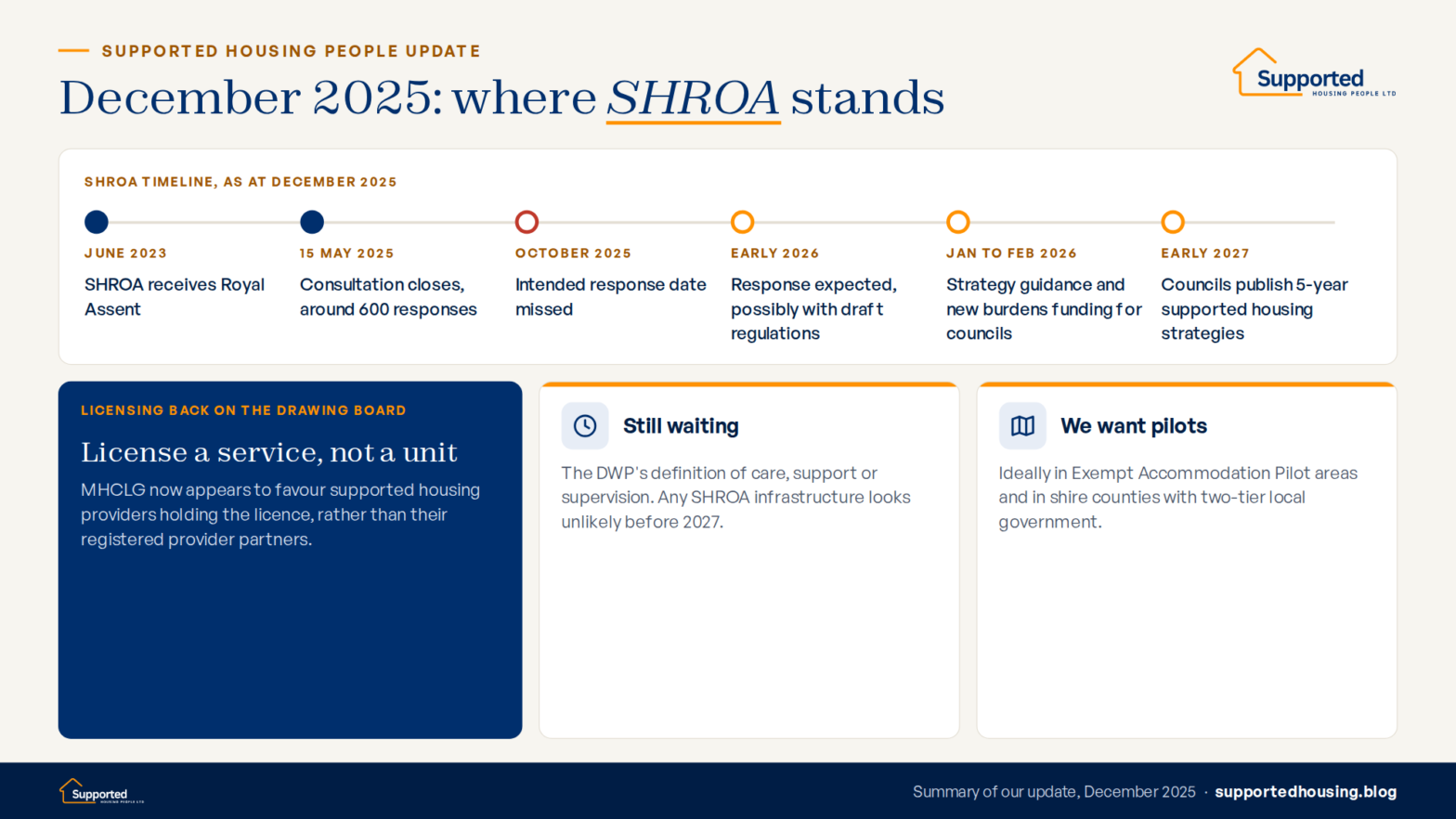
As you will probably recall, SHROA was given royal assent in June 2023. That’s two and a half years ago. Since then, we have had a prolonged silence, a General Election, another silence, a Consultation (ended 15th of May) and another protracted silence briefly interspersed by a Ministerial Statement that told us the government may consult in early 2026 on SHROA regulations developed based on the Consultation
The UK government had intended to formally respond to the Consultation by October. It hasn’t, and this appears to be as a consequence of a return to the drawing board on supported housing licensing as proposed in the Consultation.
Usually, government departments publish consultation responses; there were 600 in total, but on this occasion, they haven’t published them. It would be interesting to know why.
Licensing
SHP’s Consultation Response Template was quite critical of the proposed licensing arrangements. Especially the idea that every “unit” of supported housing (which could be a single person on housing benefit in a single room in a shared house occupied by other people not on housing benefit) should be licensed, rather than a “service” (a number of supported housing properties or units, providing comparable services within a reasonable geographical proximity and managed by the same organisational infrastructure).
As proposed, licensing might be very challenging for registered provider/supported housing agency relationships. As proposed, in an agency management situation, the registered provider (RP) would hold the licence. A condition of a licence is that the agent comply with the National Supported Housing Standards (NSHS) (see slide 9). A failure of performance by the agency in this regard would lead to the RP losing a supported housing licence and its residents being ineligible for housing benefit.
However, MHCLG now seems to be thinking about supported housing providers holding the supported housing licence, not their registered provider partners.
Pilots and Supported Housing Strategies?
Whatever the response to the Consultation, which closed on the 15th of May, it needs to be sooner rather than later. We have been told “early 2026”. As things stand, it is difficult to imagine any SHROA infrastructure being in place before 2027. We do hope there are Pilots for the implementation of SHROA infrastructure, perhaps in at least some of the Exempt Accommodation Pilot areas, as well as in shire counties, where implementation needs to acknowledge two-tier local government, whilst it still exists.
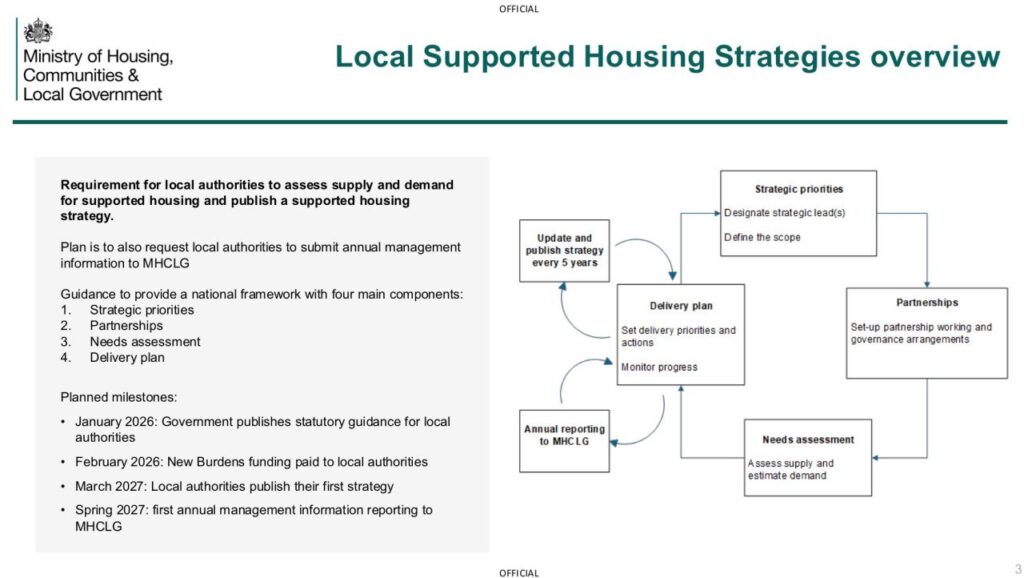
Every English local authority is required to develop a 5-year supported housing strategy under SHROA. MHCLG recently produced a timeline for the development of these strategies (see below), which also confirms that councils will receive new burdens funding and will be expected to publish their 5-year supported housing strategies by early 2027.
The 5-year supported housing strategies cover “supported exempt accommodation” only, as does SHROA. It doesn’t cover private-sector-supported housing in which domiciliary care is delivered. The housing components of these services will remain unregulated.
What is “Care, Support or Supervision”?
One area of the SHROA Consultation on which there has been very little said is around the intention for the DWP to develop a definition of “care, support or supervision” (CSS). My understanding is that the DWP has done quite a lot of work on this.
Within the SHROA Consultation, it was suggested that “care”, which has a statutory definition, is clearly not fundable through housing benefit, so any redefinition of CSS should exclude “care”. This is not contentious. The SHROA Consultation went further, suggesting that the term “supervision” be dropped as well, so that we might expect a definition of “support”. We hope it will not be a more restrictive definition than current case law allows.
The DWP and some revenue and benefits colleagues state that CSS is not eligible for funding under housing benefit. This view originates from Schedule 1, Part 1 of the Housing Benefit Regulations 2006, which says that “nursing care or personal care (including assistance at meal‑times or with personal appearance or hygiene); ……(and) charges in respect of general counselling or of any other support services” cannot be funded through the rent.
Care certainly can’t be, we can all agree on that. Neither can “counselling or…any other support services” if that refers to the services supported housing providers provide that have nothing to do with the management of the property (counselling, liaising with primary care providers, education, employment, training and so on). However, case law makes clear that certain types of Intensive Housing Management and Maintenance, which are housing benefit eligible, amount to support and supervision. It therefore cannot be the case that CSS in its entirety is ineligible for housing benefit. Please see my briefing on this topic. These case-law arguments are particularly important whilst the existing pre-SHROA Consultation arrangements remain in place.
Housing Benefit
During the SHROA Consultation, the government left the door open to the abolition of housing benefit. In 2020, I floated the idea of abolishing housing benefit for supported housing in favour of an uncapped housing component of universal credit to meet the housing and support costs of supported housing. I called it “supported housing rent”, but it’s universal credit, not housing benefit, as the latter will have been abolished. I identified the danger of a restrictive definition of “support” within such a system.
If this is what the DWP decides to do, let’s hope their definition of “support” is generous.
If you’re wondering why your housing benefit claims are subject to so much more scrutiny than they used to be, then look no further than the DWP Guidance. I comment on this in my What is “Care, Support or Supervision”, and can it be Funded through Enhanced Housing Benefit? briefing.
Nobody should complain about scrutiny of public money, especially when the supported housing ecosystem is awash with people and agencies whose sole purpose is profit. However, I am aware of a few revenue and benefits teams demanding information that is well beyond what would be considered reasonable under the Housing Benefit Regulations 2006 (paras 108, 109 and 117-119).
In addition, Regulation 86(1) of the Housing Benefit Regulations 2006 states that local authorities may request only information that is “reasonably required” to determine a claim. Overreaching requests (e.g., demanding evidence that it is unreasonable to expect a claimant or landlord to provide) can be unlawful.
This Guidance is important to understand. It states, for example, in paragraph 151 that “There is no set number of hours that must be provided for the care, support or supervision to be sufficient” (i.e., “more than minimal”). It also states, quite rightly, that we are reliant on case law to define what CSS is. My view is that the case law supports good supported housing providers to show that intensive housing management and maintenance are actually housing benefit-eligible “support”.
“Intensive Housing Management Only” Supported Housing
An area of particular scrutiny by revenues and benefits colleagues now is so-called “Intensive housing management only” supported housing. The argument goes that because CSS is “not housing benefit-eligible” and the only “other” services being provided are intensive housing management, then the amount of CSS cannot be “more than minimal” because no CSS is provided.
If you’re being told that intensive housing management and maintenance services alone are, by definition, not “more than minimal” (and therefore not supported exempt accommodation (SEA), there is case law to show that Intensive housing management and maintenance are “support”. There is case law to show that what we call “concierge” services are both support and supervision, and finally, there is case law that says it’s not the amount of hours of CSS provided, it’s whether it makes a genuine difference to the ability of the tenant to live in the accommodation.
Agency-Managed Supported Housing
There is a separate issue with some RP/agency-managed supported housing where third-party support is provided and funded by, say, adult social care or the NHS. In these circumstances, the agency will often also provide Intensive housing management services on behalf of the RP landlord, as well as non-housing benefit-eligible support commissioned and funded by the third party.
Some revenues and benefits colleagues are looking at these arrangements as specified accommodation category 2 (“managed property”). Unlike exempt accommodation (specified accommodation category 1), these schemes are dealt with under the more restrictive post-1996 housing benefit rules and often have their rents restricted as a consequence.
The fact is that case law says that Intensive housing management is “support”, and if the agency supported housing provider provides a more than minimal amount of it on behalf of the landlord, then it’s “exempt” accommodation, not “managed property”. Clearly, there will need to be a management agreement in place between the RP and the supported housing provider agent that clearly sets out the services that the agent provides on behalf of the RP.
Subsidy Loss and the Exempt Accommodation Project (EAP)
As you may know, councils have a huge issue with “subsidy loss” in supported housing at the moment. This means that where the landlord of a supported housing scheme is not a registered provider of social housing (RP) and claims housing benefit, the council that pays it can only reclaim from the DWP 60% of the difference between the applicable LHA amount and the housing benefit claim amount.
Subsidy loss in supported housing has become such an issue for councils that many have requested that their supported housing providers become RPs, or, more realistically, lease their properties to an RP, which would then become the de facto landlord, allowing the council to fully reclaim the housing benefit it pays.
In 2021, Supported Housing People established the Exempt Accommodation Project (EAP) as a brokerage to introduce local authority-approved supported housing providers to reputable registered providers. The EAP now works with five RPs and around twenty-five supported housing providers in management and development. There are over 1000 units of supported housing provider accommodation leased to EAP RPs and a further 1500 on the journey to an RP partner. The EAP already saves councils millions of pounds per year in subsidy recovery, but it’s become more than that.
The EAP is becoming what we call a “community of good practice” in which RPs and supported housing partners collaborate to share best practices in supported housing. This is especially important in the run-up to SHROA, licensing and the National Supported Housing Standards (NSHS).
The EAP already works with 5 RPs, most of them YMCAs. We’re always interested in talking to other values-based RPs that are supported housing providers in their own right. The EAP has the infrastructure, experience, credibility and values to work with more RPs who want to work with supported housing providers as part of a community of good practice. Please get in touch.
Similarly, if you’re a local authority-approved supported housing provider that has been asked by your local authority to work with an RP, please get in touch. The arrangements we broker are collaborative and mutually beneficial in the joint pursuit of being the best that we can be in working for the people we accommodate and support.
We exercise due diligence on everyone who wants to work with us. We generally do not work with property-led supported housing CICs, whether or not they’re LA-approved.
The “ideal” EAP-supported housing provider partner is an established, community-based charity or voluntary agency with a values-driven ethos, a resident focus, and a board of trustees with a track record in supported housing.
At the behest of Adult Social Care teams, we will also work with commissioned care providers within the EAP. However, our RP partners and we do undertake extensive due diligence on proposed care provider partners, up to and including their sources of capital funding/investment and their relationships to property development interests.
The EAP’s strategic work with local authorities is of particular significance to us. Several councils have specifically asked the EAP to help them with subsidy management for supported housing, which we’ve been delighted to do at their behest. One of the projects we undertook with CCC was identified as an example of good Practice in subsidy management within the LGA’s SHROA Guide for LAs (page 64).
Temporary Accommodation (TA) Subsidy Management
But it’s not just supported housing where subsidy loss is an issue. Councils have a massive problem with demand for temporary accommodation (TA), for which the subsidy loss position is even worse than for supported housing.
Some years ago, I published a briefing that discussed the idea of “TA to EA” (temporary accommodation to exempt accommodation). People who present as statutorily homeless often have CSS needs that are “more than minimal”. In these circumstances, it would be a good idea to refer such people to exempt supported housing (EA) where the landlord is an RP. The council can pay housing benefit and fully reclaim it from the DWP, whilst the homeless person is provided with support as well as housing and is consequently far less likely to be homeless in future.
A number of councils are actively pursuing this model. The EAP has the infrastructure, the RP, supported housing provider and council relationships and the technical knowledge to work with councils in the management of subsidy for both supported housing and temporary accommodation.
So whether you’re a council with a supported housing/temporary accommodation subsidy management issue, or a values-led, community-based supported housing provider or registered provider, please get in touch because we can help you and it won’t cost anything. In the case of councils, it can save you a lot of money.
Changes to Housing Benefit Disregards for Working-Age Residents in Supported Housing and Temporary Accommodation
The recent budget introduced four new earned income disregards within Housing Benefit, applicable to residents in supported housing and temporary accommodation, effective Autumn 2026. [theyworkforyou.com], [insidehousing.co.uk]
These measures are intended to reduce the current “benefits cliff edge,” that occurs when a resident of supported housing gets a job: how do you pay the rent? Supported housing is so much more expensive that other accommodation. [insidehousing.co.uk]
Approximately 200,000 working-age recipients of Housing Benefit in supported housing, and around 100,000 temporary accommodation residents will benefit from this.
Summary Points
- SHROA implementation is delayed, and the licensing model is under review.
- A comprehensive definition of “support” (as opposed to “care, support or supervision”) is critical for future funding.
- Expect further consultation in 2026 and implementation pilots; full rollout likely post-2027.
- Our focus needs to be on “IHM only” and on agency-managed supported housing with 3rd-party funding. Much turns on the case law definition of IHM as “support”.
- The EAP is central to reducing subsidy loss and preparing for SHROA licensing. It is a “community of good practice”.
- Collaboration between councils, RPs, and values-led providers is essential. The “property-led” approach to supported housing is often incompatible with the scope of housing benefit revenue and with a values-led approach.
- Changes in housing benefit disregards will have a positive impact on working-age residents in supported housing and temporary accommodation.
Hi – very informative. You state – ”However, I am aware of a few revenue and benefits teams demanding information that is well beyond what would be considered reasonable under the Housing Benefit Regulations 2006 (paras 108, 109 and 117-119)”. Do you have any examples? Its an allegation thrown at HB whenever a provider does not want to provide information or just doesn’t have it, but there is a line to be drawn as you state. It would be informative to know what is deemed beyond reasonable in this area?
Thanks Peter, the word “reasonable” is something of a lawyer’s paycheque in any context, so we have to be pragmatic.
Firstly, demands for excessive amounts of information are rare in my experience. The 2022 Guidance is quite informative, and things like records of resident engagement, staff rotas, qualifications, training standards, support plans, needs assessments, management accounts, information about commercial relationships in lease-based schemes, and more, are all fair requests in my book.
Where I would draw the line is asking a major national RP to provide detailed invoices to prove an exact utility cost in a single scheme where it has a blanket agreement with a utilities provider. These things do happen, but they are the exception.
excellent round up of SHROA. Thank you
Thak you, Mark Much appreciated. Michael.