
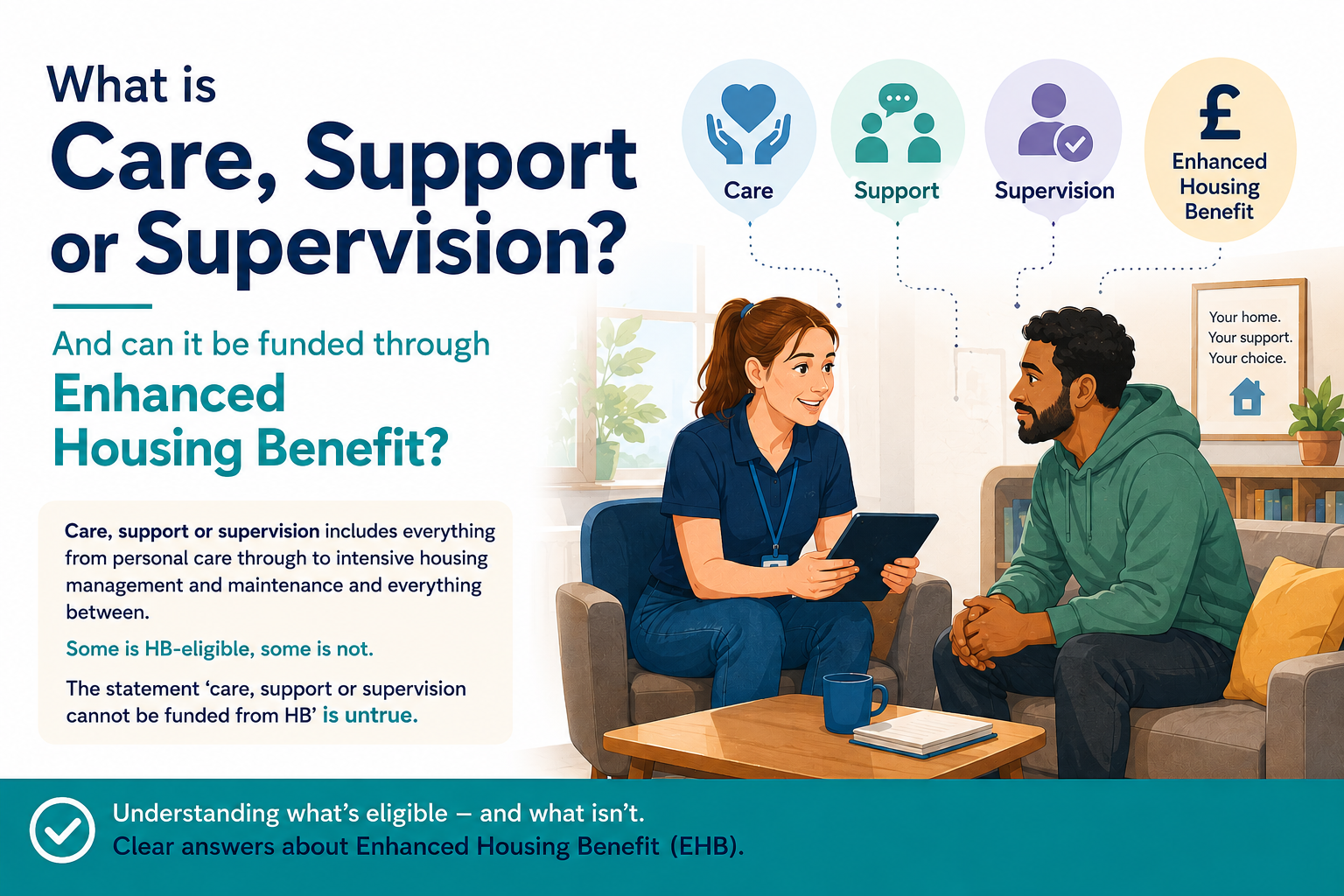
The purpose of this blog post is to challenge the notion that “care, support or supervision” (CSS) in its entirety isn’t eligible to be funded by (enhanced) housing benefit.
Case law shows that this can’t be true and that the real situation is that some “support and supervision” tasks, activities, and functions are housing benefit-eligible, and others are not.
SHROA
One of the questions (Q.81) in the Supported Housing Regulatory Oversight Act (SHROA) Consultation concerns the definition of “care, support or supervision” (CSS), which the SHROA Consultation seeks to redefine. The question is “what would you define as ‘support’ and ‘supervision’ for the purposes of Housing Benefit?”
We must take great care in dealing with this question. With the SHROA Consultation, we have the opportunity to increase funding for supported housing, but this opportunity is subject to the risk that political decisions will further restrict the scope of housing benefit available to fund supported housing.
The odd decision to restrict the scope of SHROA to supported housing that is eligible for enhanced housing benefit, i.e., “Supported Exempt Accommodation” (SEA), raises additional concerns about the UK government’s motivations.
Unfortunately, the SHROA Consultation portal (Citizen Space) only allows 2000 digits per answer, which is woefully inadequate for such a nuanced argument around how CSS should be defined.
Revenue for Supported Housing
A clear understanding of what CSS is and whether it’s partially fundable through enhanced housing benefit really matters. It matters now for current claimants of enhanced housing benefit, and it matters post the SHROA Consultation, as the UK government’s intention is to control expenditure on enhanced housing benefit, which is currently around £4 billion pa.
It is incredibly important that this Consultation is not used as an opportunity to restrict revenue for supported housing through a restrictive definition of “support” (or “supervision”). There is a lot of data that shows the financial and social cost-benefit of supported housing, for example, the 2009 Cap Gemini reports conservatively show that for every £1 invested in supported housing, between £3.50 and £7 is saved in statutory and other interventions that are not required because of the existence of supported housing. Since the Cap Gemini data were published, supported housing has taken on a higher range of needs, so the preventative cost savings will have increased significantly. And why would you reduce the size or scope of the funding source for a preventative service such as supported housing, which saves human lives and a great deal of money? Reduce investment in prevention, and you’ll increase the need for more expensive, otherwise unnecessary interventions, and a lot of human pain as a consequence.
Care, Support or Supervision
In addition, there is a well-perpetuated claim that “care, support or supervision” is not eligible for funding through enhanced housing benefit. This claim is being perpetuated by the DWP as recently as this month, in its responses to SHROA Consultation event questions, in numerous local authority revenues and benefits teams’ responses to enhanced housing benefit claims, and even in guidance on enhanced housing benefit published by parts of the sector establishment.
So, how about an alternative take on this, starting with some definitions?
“Care” can be defined in housing benefit regulations according to its statutory definitions and will not and cannot be funded by housing benefit, so we can set “care” aside. “Support” and “supervision” are different matters.
The “’care, support or supervision’ is not eligible to be funded through enhanced housing benefit” position is based on regulation 10 of the 1987 Housing Benefit regulations and Schedule 1 of the 2006 Housing Benefit Regulations. The problem is that the meaning of “support” and “supervision” has evolved over time through case law. The Housing Benefit Regulations haven’t done so in the same sense.
Added to this, the DWP Guidance on Housing Benefit Claims for Supported Housing states that “care, support and supervision are not defined in the regulations, so take their ordinary meanings.” We’re not disputing the definition of “care”, which has a statutory definition and isn’t fundable from housing benefit anyway. But what “ordinary meanings” do “support and supervision” have, except those meanings given by case law?
Non-HB eligible “support” services in this context might include:
- Emotional support and counselling
- Assistance with managing finances and budgeting (aside from assistance with and the management of housing benefit claims)
- Help with accessing community resources and services (except to the extent they have a direct bearing on the person’s accommodation.
However, the above definition of “support” does not include a range of services that case law has shown are housing benefit eligible, and also doesn’t include “supervision”, the eligibility of which is, again, reinforced by case law.
There is a commonly accepted list of routinely housing-benefit-eligible tasks and functions here: https://supportedhousing.blog/2021/04/18/intensive-housing-management-enhanced-housing-benefit. This list is often represented as being an inexhaustive list of Intensive Housing Management tasks.
The point should also be made that the staff and non-staff costs of HB-eligible overheads and maintenance services are HB-eligible.
Case Law
Both the Consultation and the DWP Guidance on Housing Benefit Claims for Supported Housing make the point that we depend on case law to determine housing benefit eligibility.
Case law has done much to change eligibility for “support and supervision” to be (partly) eligible for housing benefit, such that the insistence by the DWP, certain local authorities and parts of the supported housing sector establishment, that “care, support or supervision” is ineligible to be funded from housing benefit doesn’t stand scrutiny.
In terms of the case law CH/150/2007 and CH/4432/2006, both imply that Intensive Housing Management is “support” in the context of exempt accommodation and is fundable by enhanced Housing Benefit. So, if “support” in this context is fundable by enhanced housing benefit, because the case law tells us this, it cannot then follow that “care, support or supervision” is entirely ineligible to be funded through enhanced housing benefit.
The SHROA Consultation question (81) seeks definitions of “support” and “supervision” respectively. Given the Consultation’s suggestion that we might dispense with the word “supervision” and define eligible services only in terms of “support” post SHROA, a combined definition might be best, so that we don’t lose eligibility for support and supervision services that case law has confirmed are eligible.
It is important to note that there is currently a “de facto” de minimis rule that states that 2-3 hours of CSS per week per person on average would meet the “de minimis” threshold (i.e., the minimum amount of CSS that must be provided per person per week on average). This is based on case law stating that three hours a week of care, support, or supervision may be more than minimal (CH/1289/2007, para 21), but 10 minutes a week will not be (R(H) 7/07, paras 29 and 30). It does not form any part of regulation or guidance.
Moreover, when it comes to “more than minimal”, if Intensive Housing Management and Maintenance are actually “support” and “supervision”, and the case law and DWP Guidance identified above is applied to that view, then Intensive Housing Management and Maintenance alone would be “more than minimal” for housing benefit and exempt accommodation purposes. It shouldn’t be necessary to evidence the provision of non-HB-eligible “support” in addition.
Also, we should be mindful that “a satisfactory test for determining whether support of more than a minimal amount is provided is to ask whether the support provided was likely to make a real difference to the Claimant’s ability to live in the Property” (CH/200/2009). This doesn’t sit well with the alleged need to demonstrate a specific average amount of time spent providing CSS. Indeed, the DWP Guidance on Housing Benefit Claims for Supported Housing specifically states in paragraph 151 that “there is no set number of hours that must be provided for the care, support or supervision to be sufficient.” Given that Intensive Housing Management and Maintenance are “support” and “supervision”, and the case law and Guidance say what they say, non-HB-eligible support should not be required in addition to these in order to qualify for HB or SEA status.
Furthermore, care, support or supervision cannot simply be quantified in terms of staff time. There are HB-eligible services, such as intensive housing maintenance, where staff time is difficult to measure, and staff and non-staff costs are generally high. If you’re providing intensive housing maintenance, you can’t just quantify that in terms of front-facing “staff hours”; what about the time and material costs of providing these services? They do, after all, amount to housing benefit eligible “support” within the meaning of care, support or supervision, because, in case law terms “,…. repairs can, if required with sufficient intensity, amount to support” (CH/4432/2006), and this would be “support” of an HB-eligible nature.
“In the case of “support”, it may be that the making available of certain types of service* itself amounts to the provision of “support” within the meaning of exempt accommodation” (CH/779/2007, reported as R(H) 6/08).
*REG 12(8) of the Housing Benefit regulations 2006 “services” means services performed or facilities (including the use of furniture) provided for, or rights made available to the occupier of a dwelling. So, “support” would include more intensive maintenance, repair and replacement of furniture, fixtures and white goods.
With regard to “supervision” and associated case law R(A) 2/75 states: “Supervision can be performed “to avoid substantial danger, which may or may not in fact arise, so “supervision” must be precautionary and anticipatory, yet never result in intervention, or may be ancillary to and part of active assistance given on specific occasions to the claimant”.
R(A) 1/88: If the person is normally able to summon help when needed from someone in another room or in a nearby building, the availability of help from that person at short notice might not be sufficient to amount to “supervision”, which means being “present on guard”. Although for the purposes of exempt accommodation, it is likely that the availability of help at short notice will count as “support” if not “supervision”. Whether such “support” is or isn’t housing benefit eligible will depend on the type of support being provided. If it’s “emotional support”, it won’t be. If it’s support related to the building where a supported housing tenant lives, it will likely be eligible.
On-site staff can provide supervision by overseeing the activities and interactions within a supported housing scheme, either passively, actively, or both.
HB-eligible supervision (and support) can also be provided by “concierge” staff who attend premises on an on-call or routine basis.
So, we can see that some “support” is HB-ineligible, whilst other types of “support” are HB-eligible, so it cannot be said that “support” is, by definition, not HB-eligible.
Summary Points
For both “support” and “supervision”, eligible tasks should involve those that bear on the accommodation itself, the services it provides, and the residents’ occupation of it, where these services and tasks are not otherwise funded.
In the context of the SHROA Consultation, it is essential that none of the eligible support and supervision services established by case law is discounted from any future definition of “support.”