
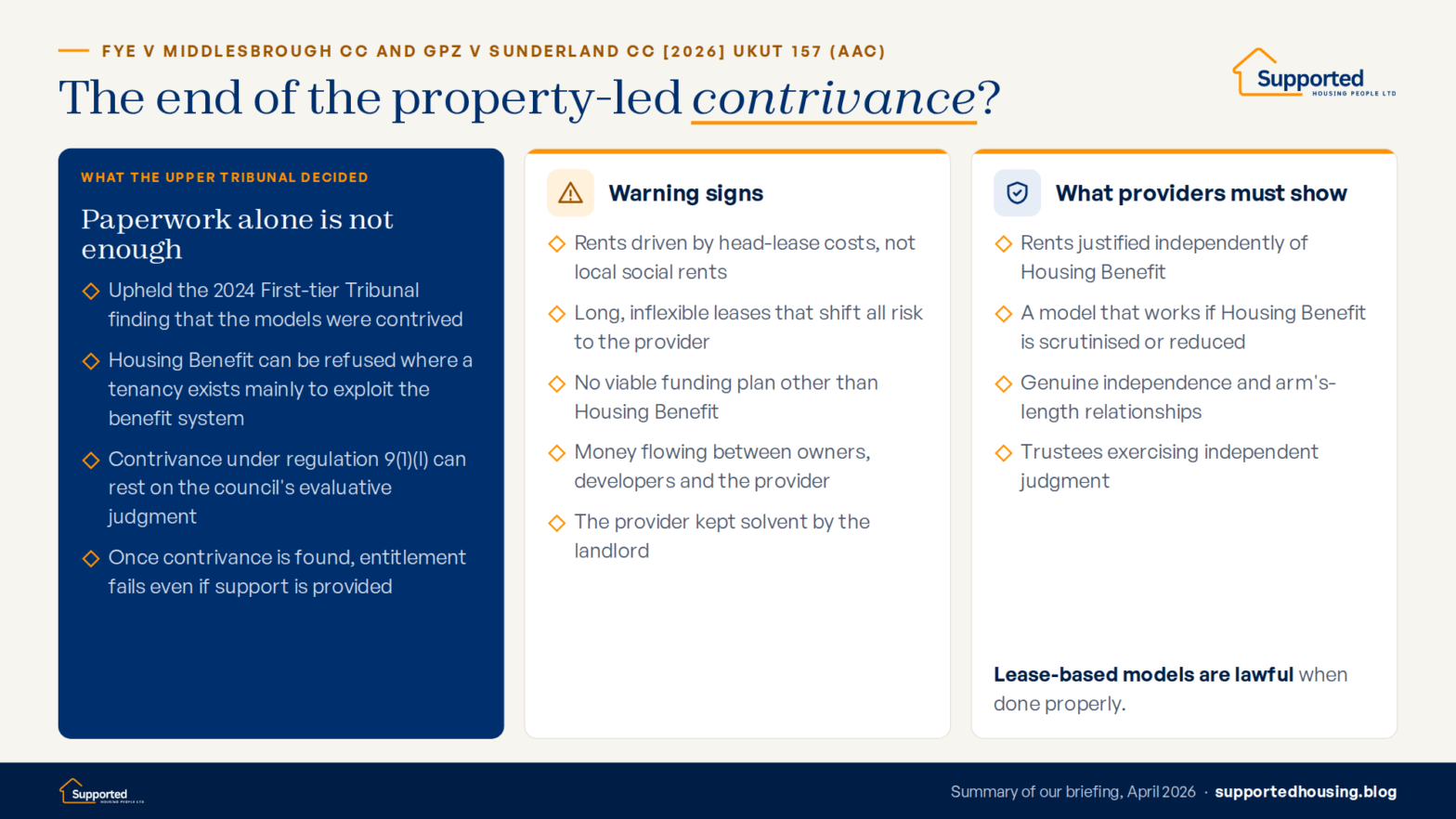
This is a Summary of FYE v Middlesbrough City Council and GPZ v Sunderland City Council
Written by Michael Patterson with some drafting assistance from AI
[2026] UKUT 157 (AAC)
Introduction
I need to bring to your attention a very recent Upper Tribunal Judgment.
Some of you may recall a BBC Panorama programme from a few years ago (https://www.bbc.co.uk/news/uk-62497015), which focused on the charity My Space Housing Solutions.
I have, for a long time, written and spoken about property-led entryism into the supported housing ecosystem by property developers, portfolio owners, lettings agents, etc., who see big profits from housing benefit, but have no emotional commitment to supported housing.
As a company we are constantly bombarded with enquiries from people wanting us to find supported housing providers to occupy their properties, or wanting us to help their newly created CIC (effectively owned by a property agency) claim HB, or telling us they’re a commissioned care provider seeking to work with a registered provider to claim HB, when actually they’re the same property agency who just tried it on with a contrived CIC. We don’t work with these people.
These are the people who stuff others with additional needs into HMOs with no communal space, who take a significant chunk of the HB as a “lease charge”, and sometimes even take more of the HB for maintenance they don’t properly carry out.
These are people with fingers in many pies: property companies, investment companies, dubious registered providers, care companies, and supported housing CICs. These intertwined arrangements are what cause the Wild West Gold Rush in places like Birmingham and elsewhere. These are people with no emotional commitment to supported housing.
These corrupt structures have leeched housing benefit from the pockets of people with additional needs for years. We’re talking millions and millions every year.
FYE v Middlesbrough City Council and GPZ v Sunderland City Council
The Upper Tribunal Judgment I’m writing about is really significant in relation to entryism into the supported housing ecosystem. It upholds a 2024 First Tier Tribunal judgment against the model used by My Space Housing Solutions and Enabling Homes, finding it contrived.
Property-led entryists, both existing and intended, should sit up and consider options other than supported housing, because the revised definition of a “contrivance” has just given councils a bigger stick to beat back the property-led invasion of the supported housing ecosystem. Remember, we have SHROA, the NSHS and Licensing coming down the line, too, and the sooner the better.
The Upper Tribunal confirmed that Housing Benefit can be refused where a tenancy is created mainly to exploit the benefit system, even if the legal structures (leases, charities, support arrangements) appear valid on paper. All too often, I hear from revenues and benefits colleagues that “we can’t refuse them. The paperwork is all there”. Now it appears that “paperwork” alone won’t cut the mustard.
In FYE and GPZ, the Tribunal upheld findings that the supported housing arrangements were contrived: the financial model, lease terms, interconnected companies, and contrived funding of “support” showed that the tenants’ liabilities were engineered to obtain Housing Benefit.
I have seen all too often examples of supported housing providers charging their residents ineligible charges of £15-£20 for the notional provision of non-HB-eligible “support” in order to comply with HB/SEA requirements. In fact, this “support” charge is unnecessary (see my Briefing on this issue), but notwithstanding that, it’s morally wrong to levy this charge on residents to attempt to comply with HB expectations, whether or not those expectations are legally correct. This is especially so when so many of these providers are simultaneously siphoning off large amounts of residents’ HB into their own pockets through a “lease charge”.
“Contrivance” under regulation 9(1)(l) of the Housing Benefit Regulations 2006 can be established on the basis of an evaluative judgment, not just fact‑finding:
- councils do not need to call decision‑makers as witnesses,
- tribunals may infer abuse from the overall structure and documents, and
- once contrivance is found, entitlement fails regardless of whether support is actually provided.
If a supported housing scheme only works because it maximises Housing Benefit through artificial arrangements, tribunals are entitled to treat it as an abuse of the scheme and refuse benefit. This has always been the case in theory, but the onus is not on a paper trail produced by a supported housing provider; it rests on the council’s evaluative judgment, without the need for excessive technical argument.
The Key Takeaways from this Judgment
1. The Upper Tribunal has reinforced a strict contrivance test
The decision confirms that councils and tribunals will look behind the paperwork and examine whether a tenancy was created mainly to unlock Housing Benefit, rather than to meet a genuine housing-and-support need.
Legality on paper is not enough. Even formally valid leases and charities can fail if the overall arrangement is considered an abuse.
2. Lease‑based models are not unlawful by any means, but they can be high-risk when their raison d’etre is to profit from public money, rather than create social value in supported housing.
The Tribunal was clear:
Lease‑based supported housing can be legitimate (and it is: when done properly; see the Exempt Accommodation Project), but it becomes vulnerable where:
- Rents are driven by head‑lease costs, not local social rent levels: this is really common with property-led entryists; it’s fundamental to the business model
- Long, inflexible leases transfer all financial risk to the provider. Shorter leases can keep maintenance as a superior landlord function, often not fulfilled, but always charged to HB.
- There is no viable funding plan other than Housing Benefit. This is problematic for many supported housing services, but where Intensive Housing Management and Maintenance are provided to a degree beyond minimal, they do constitute “support and supervision”. In circumstances where there is no contrivance, it is hoped that revenues and benefits teams will take a pragmatic view. Providers will need to demonstrate that:
- Rent levels are justified independently of HB maximisation
- The model works even if HB were scrutinised or reduced
If the scheme collapses without HB at enhanced rates, tribunals may infer contrivance. The extent to which they will consider the broader nature of the arrangement is critical. If a decision was reached purely on the basis that it’s an “HB only” scheme, that would be contrary to case law (see my Briefing)
3. The financial independence of the supported housing provider is now critical.
A major failure in this case was the financial entanglement between:
- Property owners
- Developers
- The charity/provider
- Individuals controlling all of the above
This remains very common with many property-led arrangements.
Red flags include:
- The provider is being kept solvent by loans or “donations” from the landlord
- Circular flows of money to plug gaps HB cannot lawfully fill. This is significant in cases where legitimate providers, mistakenly believing they are required to provide non-HB-eligible “support” as a condition of HB and SEA compliance, attempt to fund this unnecessary “support” component through an internal subsidy. Many do this, for example, for education, training, employment and other services to residents they’re not funded to provide. They shouldn’t be punished for that. If it’s more a case of deliberately contriving compliance, it’s a different matter.
- The same individual is controlling, funding, and profiting from multiple entities. Someone really ought to do a network diagram of the relatively few individuals in the supported housing ecosystem who have their fingers in multiple, relatively large pies.
Implication for providers:
- You must demonstrate real independence
- Arm’s‑length relationships must be genuine, not cosmetic
- Trustees must be able to show independent judgment and proper governance
If a provider cannot survive without financial support from the landlord or developer, that alone may now be sufficient to establish contrivance.
4. “Support” must be real, necessary, and properly funded
The case shows growing judicial scepticism where:
- Support exists mainly to qualify as “exempt accommodation” (even though, ironically, Intensive Housing Management and Maintenance are “support and supervision”, but that’s a different question)
- Tenants do not genuinely need or receive it
- Support funding comes from unlawful or artificial sources
Support
Even though the Upper Tribunal did not need to decide the support issue, it accepted that weak or token support damages credibility.
Implication: Providers should ensure:
- Support is documented, tailored, and delivered
- Support needs are assessed before placement
- There is a lawful and sustainable funding model for support (not hidden subsidies)
5. Councils do not need witnesses or admissions to prove contrivance
This decision is especially important procedurally:
- Councils do not need to call decision‑makers as witnesses
Tribunals will:
- Make their own findings of fact
- Apply an evaluative judgment
Contrivance can be inferred from documents, accounts, leases, and structure
Implication: Providers cannot rely on:
- Technical challenges
- Procedural fairness arguments
- “Prove what the council was thinking”
If the paperwork tells a coherent story of HB exploitation, that is enough.
6. Profits from public funds are a warning sign, even if indirect. The Regulator for Social Housing seems to have agonised for years over how to intervene with those RPs that are up to their necks in this model.
The Tribunal confirmed:
It does not matter whether profits go to:
- The charity, or
- The head landlord, or
- Related companies
What matters is whether public funds are being used unnecessarily or inappropriately.
Crucially:
- Profit is not required to prove contrivance
The test is abuse, not profitability
Implication: Even “break‑even” models may fail if they:
- Distort rent levels
- Rely on artificial arrangements
- Exist solely to extract enhanced HB
7. Expect councils to rely more heavily on this case
Practically, this decision:
- Gives councils strong legal backing
Supports refusing HB where:
- Schemes grow rapidly without a clear social purpose, as is the hallmark of the property-led entryist.
- Providers cannot explain how support is funded, but remember that Intensive Housing Management and Maintenance are “support and supervision”.
- Rent levels exceed social norms without justification
Providers should assume:
- This case will be cited in refusals, reviews, and appeals
“Contrivance” arguments are now harder to defeat once systemic flaws are shown
Concluding Observations.
Providers should be able to demonstrate:
- Genuine separation between landlord, funder, and provider
- Sustainable finances not dependent on HB maximisation
- Real, assessed, and delivered support
- Rent levels justified by housing need, not lease liabilities
- Proper charity governance and compliant trustee conduct
If a provider cannot clearly explain why its model would still make sense without enhanced Housing Benefit, it is now squarely in the danger zone, and perhaps it should be. If a supported housing scheme only works because it claims higher‑than‑normal Housing Benefit, then tribunals are now likely to view it as inherently suspicious and potentially contrived.
“Making sense without enhanced Housing Benefit” means the scheme must be genuinely viable, rational, and justifiable on its own terms, rather than a structure that exists only because Housing Benefit can be stretched to fund what is, in effect, a commercial proposition.
Good article